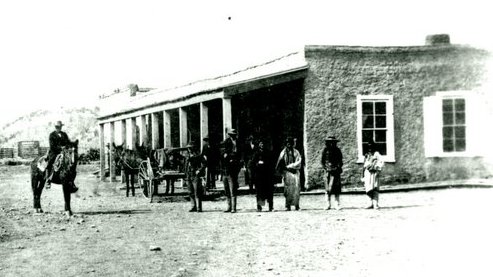
This section will explore how early Lincoln County folk lived. In the first 20 years or so the Hispano traditions were in prominence, then Anglo influence crept into the buildings and such. When Public Schools began in the 1890s folks really became more blended although the cultural differences always are there. Today when you go into a Coffee Shop in Lincoln County, you might find many old-timers conversing in Spanish however when you stop by a business you might meet a gal named Sanchez with the sweetest Texan drawl.
Buildings from the early days of New Mexico didn't use much wood in construction so coupled with the difficulty of logging and acquiring machinery, there wasn't much milled wood. The first Lumber Mill was the one that we now call Blazer's Mill. It certainly predates Lincoln County, probably going back to before 1800, it was called la Máqunia. Its location on the Tularosa River made it quite isolated and necessitated a Torreón on the grounds for defense. This mill supplied the timbers for building throughout the lower Rio Grande Valley down to the El Paso area. The next sawmill in our area sprang up in las Tables on the north side of the Capitans in the 1870s. The Salazar family from the Manzano area owned the sawmill and effectively controlled the settlement.
Adobe structures used hewn or milled wood for vigas, the horizontal pieces over the doors and windows and on the tops of walls, the larger structures used wood beams in the roof as well. Of course the walls were made up of Adobe bricks made of mud and straw and sun dried in a form. The first serious commercial structure was what became known as Casey's Mill, Lily Casey Klasner gives the dimensions about 40 feet by 100 feet, quite and imposing building. This building was built, no doubt, before 1860 and would have required bringing in lengthy beams over primitive roads from, probably, the Tularosa mill.
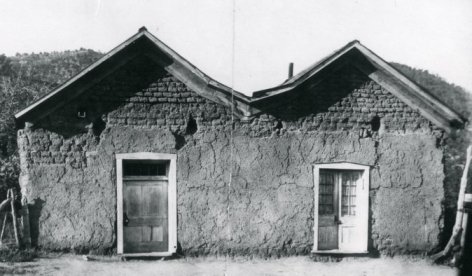
Adobe houses often had mud roofs laid over poles and branches. The floors were dirt compacted down and sprinkled with water often to keep the dust down; these could be swept with a broom. Later as folks became better off, some put down wood floors and, I suppose, by the 1900s they were building new adobe houses with wood floors.
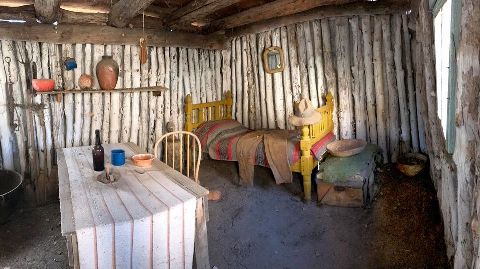
Another type of living structure was the jacale which was relatively easy to erect, it consisted of upright poles driven into the ground and laced together with twigs, vines or leather strips and then plastered inside and out with a roof of poles and mud. There is one on display in the Lincoln Monument main area.
It is important to comment that jacals were the most prevalent living place! When I was researching for my book on Historic Lincoln, I learned a lot. Lincoln town never had more than 60 adobe buildings before 1915. In the 1880 Census of Lincoln Town there were 637 individuals; do the math, for every adobe residence there must have been at least two jacals. Board buildings didn't come into vogue until the 1890s.
It might be interesting to note that the original adobe structures were built with flat roofs. Sometime, from the mid 1880s on, they were converted to a hip type roof; this was accomplished by adding more adobes to each end and then putting up beams and a traditional roof. Look around Lincoln, some of the un-restored show this, it's real interesting. Even the Tunstall Store was originally flat roofed.