Elijah Lacey Minister of the Gospel 1804-1885
An Introduction
I have spent the last 20-30 years chasing down my family
roots! Two of the most influential people in my quest, are Elijah Lacey and
Ruth McDonald Lacey. Amazon.com has a book I wrote: “Ruth McDonald Lacey and
the Spring Creek Community”
My mother, June Lacey Eastwood can be traced back to the
early colonies; The New Mexico crowd to 1500 Mexico City; the French Canadian
crowd back to the 1600s in Canada; the Lacey crowd back to the late 1600s Virginia
and before that to the deLacys of Yorkshire who came as Knights with William
the Conqueror of Normandy.
One of the unruly bits is the story of Elijah Lacey MG;
maybe this profile will help.
~Rich Eastwood~
Elijah Lacey and Ruth McDonald
I started to use the
portion of “The William Lacy and Elliott Lacy Families of New Kent and
Chesterfield Counties, Virginia” [Referenced in my work as ELB, ed.] that
pertained to Elijah and Ruth (pp. 385 THRU 388a) but I found so many erroneous
entries that I decided to re- write it.
Rev. Elijah Lacey, the youngest son and child of Lionel
Lacey and Ann Rankin, was born in Livingston Co., Ky. in 1804. The exact date
and locale of his birth is not known, since we do not know what part of
Livingston County his parents were residing at the time. They did not own
property there, so they may have been residing near Lionel’s two brothers,
Nathaniel Lacy and Kaner Lacey, or near his sister, Mary Lacey Baldwin, who
resided in a part of Livingston County which was later Caldwell.
In 1807, Lionel and Ann moved from Livingston County to the
Goshen Settlements in Illinois, near the present town of Edwardsville in
Madison County, later moving to St. Clair County, near the present town of
Millstadt. Here Lionel settled on a tract of land consisting of 320 acres, and
on the “Lacey Plantation”, Elijah grew to manhood. Lionel died in 1816, when
Elijah was only twelve years of age. The farm was operated by his elder
brothers, John and Stephen. Lionel’s will states: “to my sons Joshua Lacey,
Thomas Lacey, James Lacey, and Elijah Lacey, I Bequeath after all my just debts
are paid, all of my horses, cattle and sheep. All household furniture and all
other such property whatsoever kind or nature which by right or law appertains
unto me. This is to remain in the hands of and under the direction of my loving
wife Ann Lacey during the period of her widowhood--”. Ann never remarried and
lived until 1837. There is no record of what, if anything, the four brothers
received at that time.
At the age of 24 years, on 21 August 1828, Elijah married a
young widow, Ruth McDonald Locke, who was with child by her first husband,
Gerald Locke. A son, William Jackson Locke, was born on 21 November 1828. Ruth
was born in Tennessee in 1809, the names of her parents are not known, nor is
the date of their arrival in Illinois. Since this book was written, a lot have
things have happened that make research easier; primarily the internet. Thomas
McDonald and Joseph McDonald and their relative, Matthew Taylor, who settled in
or around Spring Creek, Gillespie County TX in the same time frame as Ruth and
Elijah; were, no doubt, from the same family that Ruth grew up in, however she
might have not been a blood relative.
Elijah and Ruth’s first child, Aciel (Asa) Phelps, was born
in St. Clair County on 18 May
1830. There is some confusion as to their exact county of
residence during this period as they appear in the 1830 census in Jefferson
County, with no children. So, it must be that Asa was not born and William
Jackson Locke was with someone else. Of course, these old returns are not
always reliable or complete. Elijah was a 2nd Lt. in the 1st Reg., Ill. Militia
(Executive Record 1832-37, Vol. 2, p.241).
Elijah is shown living in Jefferson County in 1840, by the
census of that year, but we have been unable to locate him for the two
following census reports for the years 1850 and 1860, although all of his
children were born in Illinois before 1850, and he had moved to Texas before
1860.
One of the more influential churches on early American
Frontier was the Methodist-Episcopal Church. They produced itinerant preachers
that covered to whole frontier. One of these was a man named James Axley who
preached in Elijah’s coroner of the world. Axley’s preaching no doubt affected
the Lacey family and many more.
Beyond preaching the Axleys had a significant impact on the
Lacey, McDonald, Taylor families that came to Gillespie County Texas. James’
brother, Pleasant Axley died when his children were still young; Cliff
Hazelwood, married to Nancy Axley, (James and Pleasant’s sister) took over
Guardianship of the children. Two of these were: Hannah Axley who married
Matthew Taylor and Rachel Axley who married Thomas McDonald; both families were
prominent in the Spring Creek Story. The Hazelwoods we find in Spring Creek
were members of that family as well.
At some point Elijah became a Methodist Minister and so
referred to himself on the census. He performed the marriage ceremony for his
daughter Mahala Elizabeth Lacey and John Hardin Lacey, her first cousin; and in
Gillespie County he performed several marriages for members of his family and
others. As ministers of the time were wont to do, he also practiced a little
medicine. This was because of the scarcity of qualified physicians and the
necessity and desire of a minister to take care of his flock. Elijah was known
by the nickname “Doc,” it would be a good guess that he did quite a bit of
doctoring, especially in conjunction with his ministry. The nickname was passed
on to future generations; a child named Elijah was often called “Doc.” A case
in point: My grandfather. Peter Elijah “Doc” Lacey. Another thought, others in
the Texas crowd were lay ministers but always had other professions listed;
Elijah always was listed as a Minister of the Gospel. It would seem that he was
an ordained Methodist Minister and had Church Appointments.
Around, 1855 he moved his family to Texas, but he is not
found on the 1860 census in any county in that state. However, they seem to
have first arrived in Goliad County since his son, Asa Phelps Lacey and Asa’s wife
Rosanna England, and his daughter, Mahala Elizabeth Lacey, and her husband,
John Hardin Lacey, are all found there on the 1860 census. He is found on the
1870 census for Gillespie County, together with the families of several of his
children. The 1880 Gonzales County census is the last known census record for
Elijah Lacey. There is much speculation on what happened to Elijah but the
internet has shed some light on this, as we will see.
Exactly how they moved to Texas is not known. In the 1850’s
there were established trails to Texas. One wagon road stretched from Memphis,
Tenn., to Little Rock, Ark., to Fulton, Ark., and on into Texas across the Red
River with a branch from there to the San Antonio area. That is the way the
Taylor, McDonald crowd came. However, since St. Clair County in Illinois is
right across the Mississippi from St. Louis, they probably took a steamship to
New Orleans and then sailed around to Indianola; then by wagon up to Goliad.
Before the Civil War the Laceys seemed to be mostly south of
San Antonio but Jack Locke had scouted a place just north of San Antonio. Locke
Hill was started by the W.J. ‘Jack’ Locke family and the L.M. Lacey family.
They ran a stage stop which grew into a school and adjacent cemetery; it was
ten miles from the Alamo on the Fredericksburg Road. Lewis and Margaret’s son, William Madison
Lacey, owned land there and his children were born there. This is also the area
that Lewis Cass Lacey refers to in his letter about him and brother, John
trying to farm on 20 acres. Today the Locke Hill Community is inside the city
of San Antonio, but at that time it was 10 miles from the city. The Locke Hill Cemetery
is still being used. Today it is at the corner of Fredericksburg and Hubner
roads. When Ruth died on 6 May 1877, she was buried there. John Hardin Lacey,
Lewis Madison Lacey, and little Carroll Scott Vincenz, who died while visiting
from Illinois, are also buried there. Ruth is the only one of the family with as
headstone. After the Civil War the Taylor, McDonald families and the rest of
the Laceys populated the Spring Creek neighborhood.
The children of Elijah and Ruth:
[The following
profiles vary in construction, they were created at different times for different
reasons. I just used them as is, for expedience.]
William Jackson ‘Jack’ Locke
Son of Gerald (Gerades?) Locke and Ruth McDonald
There was a Gerades Locke and some other Lockes living near
Linvil (McDaniel) McDonald, in the 1820 Census, Monroe Co. IL.
Family tradition says his father was dead but I wonder?
His mother was pregnant with him when she married Elijah
Lacey
In the 1850 Census he used the Lacey last name.
Born 21 Nov 1828 in IL
Died 11 Oct 1911 at San Antonio
Buried in the San Antonio National Cemetery
Mary England (1)
Married, 6 Sep 1848 in Marion Co., IL
Daughter of William B. England (a Methodist minister) and
Chloe Pike and sister to Rosanna who was married to Asa Phelps Lacey, Jack’s
half-brother
Born 5 Jul 1825
Died 31 Jul 1909
Buried in Lockehill Cemetery
Children of Mary and
Jack:
Mary Olive Locke
b. 6 Oct 1849
William M. Locke
b. 25 Sep 1851
Sarah J.G. Locke
b. 20 Jun 1853
Judith Ann Locke
b. 7 May 1856 d. 1946
Martha A. Locke
b. 20 Apr 1859
Stephen A. Douglas
Locke b. 17 Jun 1859
Sam Houston Locke
b. 8 Aug 1861, d. 1920
m. Lydia Myrick b. 18 Dec 1872, d. 16 Jun 1973
Girard E Locke b.
15 Sep 1863 d. 1901
Hattie Elizabeth
Locke b. 4 Apr 1865 d. 1960
m. Henry F. Horn
Sometime in the 1870’s Jack and Mary apparently divorced.
Anna M. McCarthy
(Ferguson) (2)
Married before 1880
According to the 1880
Census:
Jack was married to Anna M. (Ferguson), age 33, born in MA
Living with
him were:
Son,
Gerhard age 18
Stepdaughter,
Annie H. Ferguson, age 16, born in MO
Stepdaughter,
Hacy ? J. Ferguson, age 14, born in MO
Stepdaughter,
Mary G. Ferguson, age 12, born in MO
Daughter,
Ruth, age 4 Mo., born in TX
Mother in
Law, A. McCarthy, age 64, born in MA
Also in the
1880 Census (San Antonio Twp. Page 252, 62-66) Jack’s son William, a Surveyor,
age 28 had living with him:
Wife,
Fanny, age 25, born TX
Mother,
Mary, age 53, listed as a widow…? ?
Sister,
Judith, age 24
Brother,
Douglas, age 20
Brother,
Sam H., age 17
Sister,
Lizzie, age 16
The child of Jack and
Anna:
Ruth Locke b.
1880
Notes:
1850 – Census, Jackson Co. IL. Shown as W.J. Lacey married to Mary (Asa and
Rosanna lived nearby)
1854 – Around this year Jack, Mary and kids, with the
Laceys, moved to Texas.
1860 – Census (BEXAR COUNTY TX Page 470, 2119-2039) shows
him living in Leon Springs as a Stock Rancher, Worth $1000 - -$900
1864 – He was Captain, Texas State Troops, 3rd Frontier
District, Gillespie Co., CSA.
1865 – Later he served as a 2nd Lt. in the 2nd Texas Cavalry
U.S.A. with some of his friends and relatives.
1870 – Census (BEXAR COUNTY TX, San Antonio Twp. Page 312,
384-412) shows him as a farmer, Worth $1800 - $1350
Asa Phelps Lacey
[This essay based on
the Elton Lacey Book Pp 388b thru 392a coupled with information that has come
to light since.]
Aciel (Asa) Phelps Lacey was the eldest son of Elijah Lacey
and Ruth McDonald but the second son in the household, his mother Ruth was
pregnant with William Jackson Locke when she married Elijah in 1828. Asa was
born, May 18, 1830 in St. Clair Co. Illinois. He died 3 Apr 1913 in Asher,
Oklahoma after a restless and interesting life.
Rosanna England
and Asa were united in marriage on 25 Jul 1849 in Marion Co. Illinois.
Rosanna was the daughter of William England and Cloah Pike,
born April 23, 1829 in Illinois. Cloah was the daughter of Capt. Zebulon Pike,
and a sister to Brig. Gen. Zebulon Pike, the discoverer of Pike’s peak. Rosanna
was the sister of Asa’s half-brother, W.J. Locke’s wife Mary England. Rosanna
died 3 Apr 1907 and is buried at Hill Crest Cemetery, Morris Ranch, Texas,
along with her daughter, Cloey Cynthia Lacey Lee and Cloey’s husband, Abijah
Lee. The Lee descendants still return to the Morris Ranch reunions, held
annually, and help keep up the cemetery.
The 1850 Census finds Asa and Rosanna living in Jackson Co.
IL four families away from his half-brother William Jackson Locke (Lacey in the
Census). Asa was listed as a farmer; the Lacey Book says that he was, like his
father, a Methodist Minister but the Census always shows him in some other
occupations; perhaps he was a Methodist Lay Preacher, a common avocation at the
time.
On October 3, 1850 a daughter was born to Rosa and Asa,
Louanna Elizabeth; they were still living in Jackson County. By 1852 they had
moved to nearby Kendall County, there a son, Louis Monroe was born on August
8th. Around 1853/4 the whole Lacey clan, father Elijah and all of Asa’s
siblings, moved to Texas. If they all traveled together they made their way
down the Mississippi River and by coastal packet to Port Lavaca. Members of the
family resided in Goliad County for a while, finally settling near San Antonio,
in the LockeHill area (named later, after the W.J. Locke family) and Spring
Creek, Gillespie County in the Texas hill country. Another daughter, Ruth Jane
Lillian was born in Texas on Mar. 7, 1854 followed by Martha Melvina in 1856,
who only lived a year. By 1858 the family had made their way to San Antonio,
there, on March 26th a third daughter
was born in Texas, Cloey Cynthia. A son Samuel Houston was born in 1859 but
only lived a year as well.
When the Civil War broke out, they were living in Gillespie
County, on the edge of the frontier. The men in this part of Texas weren’t
especially pro-Confederacy; they were an independent lot that had a lot to do.
Subsistence living and the ever-present threat of Indians consumed their lives;
they had little interest in others problems and they didn’t have a history of
slave owning. At the beginning of Texas’ involvement of the war they just
ignored the call to arms but with the U.S. Army gone and most of the younger
men off to fight for the side of their choice, things started to deteriorate.
The Indians realized that defenses were weak and the local Confederate military
began stepping up pressure on what they considered disloyalty. From May of 1862
to March of 1863, a Colonel Duff and his Texas Partisan Ranger Company went on
a reign of terror throughout the Hill Country counties including Gillespie;
threatening or murdering every able bodied man of military age they could find.
With all that turmoil going on, the Laceys were blessed with
another son, Robert Elijah, born February 19, 1863 in Gillespie County. On
August 8,1863, Asa enlisted in Co. A, Mounted Regt., Col. James E. McCord, Commanding, Texas State
Troops. The Texas State Troops were a Frontier Defense organization authorized
by the Texas Legislature in 1861 to meet the threat of Indian attack in the
western frontier of the State. With the start of the Civil War, the Union
troops had been withdrawn from the forts along the Texas frontier and the
Confederate Army was too preoccupied with the war to the east to provide
adequate protection to the western frontier. The TST was under State
jurisdiction, a point that would be contested by the Confederate Government as
the war dragged on.
His enlistment card reads: “Oath of alleg. with roll; Co.
org under act of D.21.61; Serv.D Am’t of pay shown only on payroll; on
mainrolls dte.D.21-62 to Mr.1-63, state ‘Pay due from muster into serv., though
no duty shown; Co. sta. at Camp Davis D. 24.62; 5 mm rolls: 1 Ju.1-63
toAu.31-63, 1 5.63 to 5.3 1-63; 1 payroll not dated; Service shown from
Jan.1-64 to F.29-64; Served 2 mos.-Total $24; Allowances: for clothing $40.15,
Use of Horse $24, Use of Arms $8 - Total $ 90.15; amount of clothing $34.60”.
Camp Davis was located on Whitlock Creek, about four miles
from its junction with the Perdernales River. It lay half way between Camp
Llano and Camp Verde. His Commanding Officer was James M. Hunter. Hunter had
moved to Texas in 1851 to join his brother who lived in Fredericksburg. Early
on, he raised a company of eighteen men to protect the surveying parties along
the Brazos River and its Clear Fork tributary. The Frontier Regiments were on
the cutting edge of civilization at the time, and not only had to deal with the
threat of Indian attack, but as the war dragged on, it was increasingly brought
into the conflict with the Confederate government, who wanted the manpower it
represented for the war in the east. Giving way to repeated efforts to
conscript the members into the Confederate Army, the State Government
transferred the Frontier Regiments to Confederate service at the end of 1864. A
new outfit, consisting of older men or men with some other deferment; in the
Gillespie Co. area, the Third Frontier District, Major James Hunter commanding
was formed in Jan 1865. After the war, the Union Army once again became
responsible for the defense of the frontier and reoccupied the federal forts it
had abandoned. Still, local “Minute Men” of the Texas Rangers continued to
protect the frontier through the end of the century.
The fact that Asa was required to take an “Oath of
Allegiance” was unusual. Perhaps it was because he was from Illinois, or
perhaps they had some reason to suspect his loyalty to the Confederate cause.
If it was the latter, it was with good cause, because in 1864, he deserted the
Confederates and made his way to Union lines and he enlisted in the First Texas
Cavalry, a Union Army unit, joining his brother, Joshua Collins Lacey, and his
half-brother, William Jackson Locke. It was no small feat switching sides, see
the article: “Memoirs of ‘Lafe’ McDonald” in this collection; by the way ‘Lafe’
was a cousin of Asa’s.
The First Texas Cavalry was a Union unit organized at New
Orleans, Louisiana, and mustered into Federal Service in that city on November
6, 1862. This unit’s commanding officer at that time was Edmund J. Davis, who
had been a District Judge for the lower Rio Grande Valley for a number of years
prior to the secession of Texas. He had been a candidate for a delegate’s seat
to the Texas secession convention, but was defeated in the election. From that
point on, he was violently opposed to secession, fleeing the state in the
summer of 1861.
This picture of Asa Phelps Lacey was taken in New Orleans,
probably while he was on duty there.

The majority of the members of the regiment were from east
Texas. The Second Texas Cavalry, which was never fully organized as a separate
unit, consolidated with the First on November 1, 1864. The unit served within
the states of Texas and Louisiana during its career. On May 23, 1865, it was
ordered to Vidalia, Louisiana, and remained on duty there until June 29, 1865.
From there it was transferred to Texas, serving in a number of locations around
the eastern part of the state. The regiment was mustered out of Federal service
at Houston, Texas, on November 4, 1865.
The Records and Pension Office state that he was enrolled on
May1, 1864, and mustered out on October 31, 1865. His name was shown as A.P.
Lacey and as Asa P. Lacey. During that period, the rolls show him present as
follows: Dec. 31, 1864 on Det. ser. at Morgan, La.; Feb. 28, 1865 detached in
recruiting- present at New Orleans, La.; April 30, 1865 absent with ---- Ark.
Sentenced $5 fine by G.C.M. at N.O.; Medical records show that he had acute
dysentery Sept. 11th & 12th, 1864-returned to duty. No additional
information was given.
After the war, they lived in Gillespie County where their
last child, Benjamin Butler, was born on 8 Aug 1866; and daughter Louanna
married cousin William Augustus McDonald in 1867. The 1870 census for this
county shows that the Elijah, Asa Phelps, John Hardin, and Joshua Collins Lacey
families all resided there. Asa was
listed as a Stock Raiser with personal property valued at $1100, a good sum in
those days. Son, Louis, married Mary Elizabeth McGuire Helfer in 1871. Several
of Asa’s kin joined the Texas Ranger Frontier Forces, Minute Men of Gillespie
Co., Co. F., Lt. Joshua Collins Lacey, commanding officer (Asa’s younger
brother). Asa is shown as a private, enlisted
April 18, 1872, discharged April
23, 1874, 130 days of service; Ranger Muster Roll. They were only paid for the
actual time they were called into service. During this period, Indian bands
(mostly Comanche in Gillespie County), renegades, and bandits, all roamed and
raided in the frontier areas of Texas. Lewis Cass Lacey, Louis Monroe Lacey,
and Thomas Monroe Lacey were all in this company at the same time.
In June of 1873, daughter Ruth, married Bill Alexander in
Kendall County, TX. Asa continued to move his family around. He seemed to want
to live in the frontier; this was true ever since coming to Texas. Gillespie
County was the jumping of place for many headed West, in the 1870’s there were
tales of gold being found in Lincoln County NM, as well as the need for beef in
that county. Perhaps Asa took his herd of stock to Lincoln County; for by the
1880 Census the family was in White Oaks, Lincoln County New Mexico, where Asa
gave his occupation as a miner. Robert and Benjamin were with them. They owned
a ranch six miles South East of White Oaks which they sold for $1000, in 1883,
in preparation to their return to Gillespie County. Ruth and her husband Bill
were with them in White Oaks as well; they left in 1885/6 to return to Texas.
Son, Benjamin, married Nettie Taylor on 11 Feb 1887 in
Gillespie County, the daughter of cousin, Thurman Taylor; the last son to get
married was Robert who married Emily Alice New on 2 Aug 1887. The travel lust
must have overtaken them again soon after; Benjamin and Nettie had a baby in
White Oaks, NM in 1888 and by 1890 Asa and Benjamin and their flock were in
Tacoma, Washington. They were there at least through 1892 then moving to
Gilliam County, Oregon. He left his family while they were in Oregon, leaving
them ignorant of his whereabouts. Benjamin also left his young family there
about this same time.
In the 1895 state census of veterans, he was listed as
living in far north Texas. Mrs. Grace Lacey McCandless, granddaughter of Asa,
states that he was quite a rover and that her father said that they hardly
became settled in one spot, when he would pull up stakes and move again.
Rosanna returned to Texas but Benjamin’s family stayed there.
After a period of time, thinking that he must be dead,
Rosanna applied for a widow’s pension on his Civil War service. The answer came
back that he was he alive, and drawing his pension while residing in the
Oklahoma Territory. He had applied for that Civil War pension on 11 March 1907,
while a resident of Pottawatomie Co., Oklahoma Territory. He was 76 years old
at the time. In his application, he states that he was enrolled at Brownsville,
Tex., in May 1864, as a private in Co. A, 1st Texas Cavalry, and that he was
discharged in San Antonio, Texas in Oct. or Nov. 1865. His personal description
was given as 5’ 11” in hght., a wheelwright (one that builds and repairs
wheels), and that he was born in St. Clair Co., Ill. He stated that his places
of residence were as follows: Gillespie Co., Tex. until 1882; Lincoln Co.,
N.M., to 1885; Gillispie Co., Tex. to 1890; Tacoma, Washington, to 1892;
Gilliam Co., Oregon, to 1895; Boone Co., Ark., to 1896; Indian Territory, Ark.
and Pottawatomie Co., ever since. Pension No. 607100. His post office address
was Asher, Pottawatomie Co., Oklahoma. Witnesses to his application were Jacob
H. Courtney and J. R. Childress. In his supplemental declaration, dated June 4,
1898, he stated that he was married to Rosanna England on July 26,1849 Marion Co., Illinois, by Wm. England,
Minister (father of Rosanna). He listed his children as Luanna Elizabeth, b.
1850; Rutha, b. 1853; Cloey Cintha, b. 1856; Robt. E. Lacey, b. 1862; B.B.
Lacey, b. 1866. The document was signed by Asa P. Lacey. He was last paid
on May 4, 1913, when his name was
dropped because of death. His pension was $27.00 per mo. (War Dept. Gen. Ser.
Adm., Nat. Archives and Records Section.)
When she returned to Texas, Rosanna went to live with her
daughter Cynthia and the Lee family on Morris Ranch in Gillespie Co. She died
there April 4, 1906 and is buried there in Hillcrest Cemetery with her friends
and some of her relatives.
You would think that
this was quite a life, but the Laceys are full of surprises.
John B. Lacey, Asa’s brother, served in
the same outfit as brother Lewis Lacey during the Civil War. In that same
outfit were the Alexander brothers, no relation to Asa’s son-in-law Bill; their
sister Catherine had married Thurman Taylor and was Asa’s son’s mother-in-law.
Brother William married Asa’s sister Nancy Lacey and brother “Lum” married
another sister of Asa’s, Mary. Another sister of the Alexanders, “Anne” married
Asa’s cousin “Rat” Fairchild who was step brother to Mary Jane Chesser. Mary
Jane married Asa’s youngest brother Thomas and she had a twin sister, Sina, who
married John B. Lacey. This little illustration seems confusing but at the same
time amusing and informative about life with the greater family group.
Back to
John B. - in 1880 he and his new wife Susan were living in Gonzales Co. not far
from San Antonio with his and Sina’s children: Ira, James, Premy and Lydia
(born about 1877) as well as their new baby William. In the 1900 Census of Van Buren Co. Arkansas
finds Asa P. Lacey (age 70) married to Lydia Lacey (age23) (see e-mail below)
and in the 1910 Census of Pottawatomie Co. Oklahoma are Asa and Lydia with a
seven year old daughter, Rosa M. Lacey.
If that isn’t an adventuresome life I don’t
know what is! Rich Eastwood
Asa and Rosanna had eight children, we present their data
next.
Louanna Elizabeth
Lacey
b. 3 Oct 1850 in Jackson County, IL
d. 8 Aug 1937 in Harper, TX
m. William Augustus McDonald 25 Jul 1867 in Gillespie Co. TX
b. 30 May
1847 in IL
d. 9 Feb
1918 in Spring Creek, Gillespie Co. TX
Louis Monroe Lacey
b. 8 Aug 1852 in Kendall County, IL
d. 14 Nov 1887 in Alice, TX
m. Mary Elizabeth McGuire Helfer 24 Nov 1871 in Kerr County,
TX
b. 23 Jul
1849 in LA
d. 31 Jan
1922 in San Angelo, TX
Ruth Jane Lillian
Lacey
b. 7 Mar 1854 in TX
d. 19 Jan 1917 in Mason, Mason Co., TX
buried, Bluff Creek Cemetery, Mason
m. John William Alexander 15 Jun 1873 in Kendall Co., TX
b. 29 Apr
1846 in Bellview, Iowa
d. Jun 1900
in Brady, TX
Martha Melvina Lacey
b. 19 Jun 1856, d. 3 Nov 1857
Cloey Cynthia Lacey
b. 26 Mar 1858 in San Antonio, TX
d. 2 Feb 1919 in Gillespie Co., TX
buried,Hillcrest Cemetery, Morris Ranch, TX
m. Abijah A. Lee 22 Apr 1875 in Fredericksburg, Gillespie
Co., TX
b. 1 Nov
1850 in Monroe Co., TN
d. 26 Feb
1922 in Gillespie County, TX
buried,
Hillcrest Cemetery, Morris Ranch, TX
Samuel Houston Lacey
b. 9 Sep 1859, d, 30 Sep 1860
Robert Elijah Lacey
b. 19 Feb 1863 in Gillespie County, TX
d. 27 Oct 1922 in Berryville, AR
m. Emily Alice New 2 Aug 1887 in Gillespie Co., TX
b. 24 Jan
1869 in Gillespie Co., TX
d. 9 Nov
1956 in Kerrville, Kerr Co., TX
Benjamin Butler Lacey
b. 8 Aug 1866 in Fredericksburg, TX
d. 22 Apr 1928
m. (1) Nettie Taylor 11 Feb 1887 in Gillespie Co., TX
b. 1 Feb
1872 in Gillespie Co., TX
d. 23 Nov
1930 in Eugene, OR
Divorced
m. (2) Birdie Perry
b. 21 Dec
1869 in TX 1896 in San Antonio, TX
d. 14 Sep
1953 in San Antonio, TX
The child of Asa and Lydia
Rosa M. Lacey
b. 1903 in AR
m. Satterfield
Just for fun I am
including an e-mail from Robert Satterfield:
Hi
Rich, I started my research on Austin Patton Tate my mother's stepfather
who married Lydia E. Lacey in 1913, she was born in Texas 1877. My mother was
born 1903 in Arkansas. I found Lydia E. on 1880 census Gonzales, TX with
John B. Lacy (born 1844 Illinois). A son of my mother's half sister has a bible
with John B. and Sina Chesser as parents of Lydia.............. I found Lydia
in 1900 census (Arkansas Van Buren Co. District 134 Wheeler Township) married
to Asa P. Lacey (B 1830.Illinois) On this same page I find Austin Patton
Tate and family........1910 Census (Ok, Pottawatomie Co, Avoca) Asa P. Lacey,
Lydia E. and my mother Rosa M. Lacey. Avoca was township, Asher was the
town (Post Office). ....Asa died in Asher Ok in 1913. This has been
like a connect the dots puzzle (unfinished)......Thanks for
everything.......Robert Satterfield
From the 1880 Census,
LC, White Oaks, Family 10
10 Lacey, Aciel m 50 Mining IL
10 Lacey, Rosa f 52 Wife Keeping
House IL
10 Lacey, Robert m 18 Son Laborer TX
10 Lacey,
Benjamin m 14 Son Herder TX
From the 1885 Census, LC, Pct.8, White Oaks, Family134
133 Lacey, Asa T. w m 55 x Ranchman IL
134 Lacey, Rosana w f 56 Wife x IL
134 Lacey Benjamin
B. w m 19 Son x Farmer TX
Mahala Elizabeth Lacey
Daughter of Elijah Lacey and Ruth McDonald
Born in 1834 in IL
Died in 1907 in Greenlee Co., AZ
Buried in Greenlee Co., AZ
John Hardin Lacey
Married, 16 Jul 1853 in Jefferson Co., IL
John: Son of James
Lacey and Nancy Mosby Johnston
Born 3 Mar
1831 I Monroe Co., IL
Died 4 Jun
1873 near San Antonio, TX
Buried in
Locke Hill Cemetery, San Antonio
William Cannon
Married 1878
Son of John and Catherine Cannon
from Ireland
Born abt. 1840 in Alabama
[ELB 451, 502, 507 THRU 511]
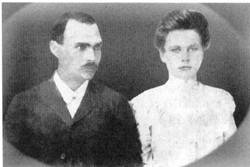 Mahala Elizabeth Lacey
was born in 1834 in southern Illinois. As mentioned
previously, she married her first cousin, John Hardin Lacey, on 16 July 1853,
in Jefferson Co., Ill. Her father, Rev. Elijah Lacey, performed the marriage
ceremony, and the next year they joined him, and his family, in moving to
Texas. It is probable that the picture in the file of John Hardin and Mahala
Elizabeth Lacey was taken on their wedding day, or around that time. It was
almost totally faded and has been enhanced by computer technology. All of their
eight children were born in Texas, one each in 1864 and 1865. It may be that
John H. was out of the war by that time. It is known that he was in the battle
of Stones River as previously cited, and that he fought against his two
brothers there, with Theophilus Lacey being killed outright, and James Lacey
later dying from complications from his wounds. John would pay a visit to
Illinois after the war. They would name their third son, born in 1864, after
Theophilus, and he would be known by the nickname “Tobe”. Tobe would raise a
large family and later move to Arizona, taking his widowed mother with him,
where she would spend the rest of her days.
The children of Mahala
and John:
Alexander Lacey
b. 1856, Goliad Co., TX
d. 9 Sep 1874, Locke Hill, Bexar Co., TX
Emily Elizabeth Lacey
b. 1858, Goliad Co., TX
d. 27 Nov 1921, Phoenix, AZ
buried, Calvary Cemetery, Douglas, AZ
m. William Bowman, 27 Mar 1874, Spring Creek, Gillespie Co.
b. Dec 1849
in KY
John David Lacey
b. 5 Jan 1859, Bexar Co., TX
d. 9 May 1905, Barksdale, Edwards Co., TX
buried, Barksdale, Edwards Co., TX
m. Mary Jemima Ann Lockwood, 4 Sep 1876, Burnet Co., TX
Daughter of
William S. Lockwood and Jane Grindstaff
b. 13 Feb
1857, Burnet Co., TX
d. 3 Apr
1947, Barksdale, TX
buried,
Barksdale, TX
Elijah Lacey
b. 1862 in TX
Theophilus (Tobe)
Lacey
b. 12 Dec 1863, Fredericksburg, Gillespie Co., TX
d. 24 Jan 1937, Wickenburg, AZ
buried, Wickenburg Cemetery
m. (1) Annie Clements, 2 Feb 1882, Uvalde Co., TX
Daughter of
William Jasper Clements and Elenora Kirkwood
b. 10 Jul
1865
d. 10 May
1954, Phoenix, AZ
m. (2) Susie Mahalia Inabelle Janes, 20 Jul 1886, Uvalde, TX
Daughter of
Edward Robert Janes and Hannah Permelia Taylor
b. 18 Sep
1866, Kimble County, TX
d. 22 Jul
1911, Douglas, AZ
buried,
Cottonwood Cemetery, AZ
Ruthie Maud Lacey
b. 15 May 1865, Gillespie Co., TX
d. 25 Feb 1944, Denison, Grayson Co., TX
buried, Humble, Harris Co., TX
m. (1) Thomas I. Richards, 2 Oct 1878, Bexar Co., TX
b. 6 Dec
1859, Albany, Dougherty Co., GA
d. 18 Oct
1900, Dewitt Co., TX
m. (2) John Norman, in 1909 in TX
b. 1857 in
TX
m. (3) William Glover, 26 Aug 1922, Gonzales Co., TX
Thomas Lacey
b. abt. 1871
d. 14 Mar 1947, Prescott, AZ
m. Mollie Boales, 23 Aug 1890 in TX
Divorced
Jacob ‘Jake’ Edward
Lacey
b. Jun 1872, Gillespie Co., TX
d. 16 Nov 1928, Las Vegas, N. M.
buried, Hospital Cemetery, Las Vegas, NM
m. Margarete Jones, 13 Feb 1899, Silver City, NM
b. Jan 1882
in TX
Lewis Madison Lacey
Son of Elijah Lacey and Ruth McDonald
Born 17 Oct 1835 in Springfield, Sangamon Co., IL
Died 21 Jul 1900 in San Antonio, TX
Buried in Locke Hill Cemetery
Margaret Lodriski Ann
White, Married 7 Mar 1861
Daughter of Peter White and Mahala McCulloch
Born 23 Jan 1844 Texana, Jackson Co., TX
Died 16 Apr 1914 Bexar County, TX
Buried in Locke Hill Cemetery, San Antonio, TX
Mahala McCulloch was the sister of Samuel McCulloch Jr.
Texas Revolution hero.
[ELB 528 THRU 532]
Lewis Madison Lacey
was born on 17 October 1835 in Springfield, Sangamon, Co.,
Ill, and died on 21 July 1900 and is buried in the Locke Hill Community
Cemetery, Bexar County, Texas. He had moved there after the Civil War and
operated a grocery store, owned land and raised cattle in the area. Lewis came
to Texas with his father, Rev. Elijah Lacey. He, and his half-brother, William
Jackson Locke, had interest in land around the Locke Hill area. It is
interesting to note that he served in the Confederate Army and William served
in the Union Army, First Texas Cavalry, yet they were still friends after the
war and William signed as witness to his pension application on 16 May 1900, as
did his brother-in-law, Austin White.
Lewis married Margaret Lodridski Ann White on 7 March 1861
in Goliad Co., Tex. Margaret was the seventh child of Peter White and Nancy
McCullough. Peter White was born on 9 July 1801 and came to Texas from
Missouri. He was in Stephen F. Austin’s Third Colony, and had a Spanish Land
Grant in Jackson Co. During the war for Texas Independence, he was in Gen. Sam
Houston’s Texian Army in the quartermaster corp, and was foraging for feed and
supplies for that army at the Battle of San Jacinto. He fought at the Battle of
Plum Creek against the Comanches, serving under Capt. Caldwell. He was also a
private in the Texas Volunteers under Capt. Lafayette Nance in 1842, and was a
private in the Mexican War in Capt. P. H. Bell’s Co. of Mounted Texas
Volunteers. Some time after 1854 he moved his family to Goliad Co. According to
records of the Texas State Archives, Lewis Madison’s family also resided in
Goliad Co. for the duration of the war. They are listed on the indigent roles
there for 1864 and 1865.
Lewis joined the Confederate Army, enlisting on 25 April
1862 in Victoria Co., Tex. He was signed by Capt. William M. Blair of Waller’s
Battalion of the Texas Cavalry, and was mustered in to service at Hempstead,
Waller Co., by Maj. E. Waller, and is shown on the Muster Roll of June 30,
1862, at Camp Waller. He is listed in this and other records as Sergeant. He
furnished his own horse, valued at $125.00, and equipment valued at $30.00. The
last muster roll he is shown on is that of 29 Feb. 1864, but in his application
for pension, he states that he served from 1862 to 1865. It is a family story
that he and Asa Phelps Lacey were both involved in the same skirmish in Louisiana
at some point, but we do not have verification. Asa was in the (Union) First
Texas Cavalry with Capt. William J. Locke.
Capt. William M. Blair’s Co. subsequently became Co. D of
Waller’s Regiment, Texas Cavalry, which was first organized as the 13th, or
Waller’s Battalion, Texas Cavalry, with five companies, A to E. Company F was
enlisted in Louisiana, 8-27-1862. An unidentified company, Capt. Menard’s,
Capt, Goode’s and Capt. Dunn’s Companies, Texas Cavalry, were added from time
to time to complete the regiment. Capt. Smith’s Company, 25th Regiment Texas
Cavalry, was transferred to this organization in exchange for Capt. Goode’s
Company by S.0. 87, Hdgs. Dist of Tex., N.M. and Ariz. dated March 28th, 1865.
(Records, General Services Adm., National Archives and Records Service,
Washington, D.C.)
As stated above, Lewis Madison Lacey moved his family to
Goliad Co. for the duration of the war. They probably moved there because the
White family resided in this county. After his return from the war, he moved
back to the Locke Hill Community and became a storekeeper until his death. He
was interred in the Locke Hill Cemetery, but has no marker, as is true of John
Hardin Lacey and others in the Lacey family buried there.
In his pension application, Lewis states that he was sick
with asthma. It was approved on 9 July 1900. After his death on 21 July 1900,
Margaret applied for a widow’s pension on 12 November 1900. It was disapproved
on 28 March 1901, the reason given was that she had “too much property”. At that
time, she listed one homestead, valued at $1000. This house is located at 737
Kentucky Ave, San Antonio, Tex., and is still lived in today. [It was demolished in 2007]
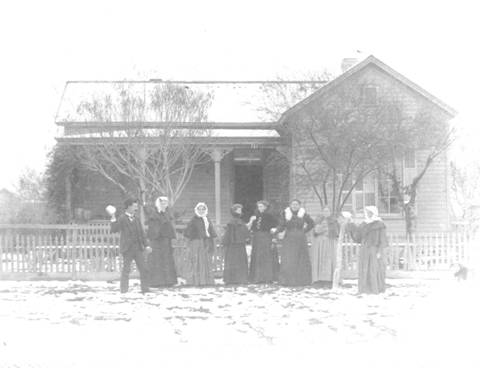
Here is a picture of
Margaret Ann L. White and some of her family and friends in front of her house
at 737 Kentucky Ave. Left to right: John Thompson, Willie Griffith, Elzada
Lacey, Emma Lacey, Mrs. Kerbel, Margaret White Lacey, and Victoria Lacey.
The children of Margaret and Lewis:
William Madison Lacey
b. 23 Jan 1862, LockeHill Community, Bexar Co., TX
d. 27 Nov 1900, San Antonio, TX
buried, City Cemetery No. 1, San Antonio
m. Elizabeth Isabel Gandine, 9 Jun 1891, San Antonio, TX
Daughter of
Joe Gandine and Elizabeth Strohmeyer
b. Aug 1872
d. 6 May
1953, San Antonio, TX
Elzada Lacey
b. 25 Nov 1865, LockeHill, Bexar Co., TX
d. 25 Oct 1911
Austin Lacey
b. 7 Dec 1867
d. 22 Feb 1884
Peter Elijah “Doc”
Lacey
b. 1 May 1870, Locke Hill Comm., Bexar Co., TX
d. 20 Jan 1937
buried, Sierra Madre, CA
m. Fannie Lalone
Daughter of
Theophilus Lalonde (Lalone) and Estanislada Padilla
b. 3 Dec
1876, Lincoln Co., MN
Theodisa L. Lacey
b. l7 Dec 1871, LockeHill, Bexar Co., TX
d. 7 May 1910, Bexar County, TX
buried, LockeHill Cemetery, Bexar Co., TX.
m. Yancie McAlpine, 16 Sep 1901, Bexar County, TX
Edmund L. Lacey
b. 18 Sep 1873, LockeHill, Bexar Co., TX
d. 15 Oct 1873, Bexar County, TX
buried, LockeHill Cemetery, Bexar Co., TX
Elmer Jackson Lacey
b. 14 Aug 1874, LockeHill, Bexar Co., TX
d. 4 Jun 1919
buried, San Antonio, Bexar County, TX
m. Margie Sheehan in 1916
Victoria Mae Lacey
b. 24 Apr 1876, LockeHill, Bexar Co., TX
m. (1) John Henry Thompson, 31 May 1899, San Antonio, TX
d. 4 Aug
1910, San Antonio, TX
m. (2) George Southwell, 1920
b. 20 Oct
1866,
d. 7 May
1934
Conley Clifton Lacey
b. 16 Dec 1878, LockeHill, Bexar Co., TX
d. 12 Nov 1956, San Antonio, TX
m. Willie Griffen, 5 Jan 1905, San Antonio, TX
Daughter of
Alfred Griffen and Olivia Callaway
b. 10 Apr
1879
d. 30 May
1968
Pearl Herbert Lacey
b. 25 Jul 1881, LockeHill, Bexar Co., TX
d. 27 Sep 1941, San Antonio, TX
m. Pearl Shaw, 31 Mar 1904, San Antonio, TX
Ed. White Lacey
b. 21 Feb 1887, Locke Hill, Bexar Co., TX
d. 4 Apr 1887
Nancy M.C. Lacey
Daughter of Elijah Lacey and Ruth McDonald
Born in Illinois in 1838
William M. Alexander,
Married on 13 January 1864 in Gillespie Co. TX.
William was born on 27 July 1839 in LA
Notes: During the Civil War William served in the same
company as his brother, ‘Lum’ and Lewis Lacey; Co. D, Wallers Battalion,
Cavalry, CSA. ‘Lum’ married Nancy’s sister Mary.
The children of Nancy
and William:
William Thomas
Alexander
Louis Elijah
Alexander
Maggie Alexander
Source: Elton Lacey
Book: “The William Lacy and Elliott Lacy Families of New Kent and Chesterfield
Counties, Virginia - with forebearers and descendants” by Hubert Wesley Lacey
and Howard Elton Lacey. And RDE research
Mary Matilda Lacey
Daughter of Elijah Lacey and Ruth McDonald
Born ca.1840 in Ill., probably in St. Clair County.
Died 21 Nov 1894, buried Nichols Cemetery, Kerrville, Kerr
County
She married three times.
Morgan McDaniel (1)
Married on 27 October 1855 in Gillespie Co., TX (Bk. 1, p.
26).
They had five children. Some of the children adopted the
name McDonald and their children carry the name McDonald. Morgan died.
Henry Hartmann (2)
Married on 26 Oct 1861 in Gillespie County. He left her and
she obtained a divorce.
Marion Columbus ‘Lum’
Alexander (3)
Married in 28 Aug 1865 or 1863, in Fredericksburg, Gillespie
County, Tex.
Lum:
Born in 1840 in Claiborne, Bossier Parrish, LA
Died in Kerr Co., TX
Buried in Ingram, Kerr Co.
Note: During the Civil War Marion Columbus ‘Lum’ served in
the same company as his brother William and Lewis Lacey; Co. D, Waller’s
Battalion of Cavalry, CSA.
Mary and Morgan’s children:
Ruth McDaniel
b. 29 Nov 1856 (twin)
d. 23 Jul 1857
Josephine McDaniel
d. 29 Nov 1856 (twin)
Marvin Levi
McDaniel/McDonald
b. 5 Jan 1858 (twin), Gillespie County, TX
Elijah L.
McDaniel/McDonald
b. 5 Jan 1858 (twin), Gillespie Co., TX
Silva Bellzora
McDaniel
b. 2 Jul 1859, TX
d. 17 Oct 1860, TX
Lois Margaret
McDaniel/McDonald
Spouse: ¿Mr. Hartman?
Marvin Levi McDaniel adopted the name McDonald, as did his
twin brother, Elijah L. He moved his family to Oregon. His sister, Lois
Margaret, also adopted the name McDonald and moved to Oregon with him.
Next we present the
children of Mary Matilda and Marion Columbus Alexander.
Cynthia Lou Ann
Alexander (twin)
b. 1 Jan 1864 (Her tombstone says 1867), Bexar County, TX
d. May 1947, Harper, TX
m. (1) Erastus Fairchild, 1885
Son of Amos Fairchild and Lucretia Jane McDonald
b. 12 Apr 1860, Vandalia, IL
d. 10 Jan 1933, Harper, TX
m (2) Hez Warden Fairchild, 18 May 1944
Erastus’ brother
b. 17 Nov 1959, TX
d. 17 Jun 1952, Harper, Gillespie Co., TX
buried, Harper Cemetery, Gillespie Co., TX
Permelia Caroline
Alexander (twin)
b. 1 Jan 1864 (Her tombstone says 1867)
d. 1873 (Died from Measles, buried Hunt-Japonica Cemetery,
Hunt Co. TX)
Franklin ‘Monroe’
Alexander
b. 13 May 1868, Fredericksburg, Gillispie Co., TX
d. 15 Dec 1949
m. Rhoda Permelia McDonald, 20 Dec 1891, Fredericksburg,
Gillispie Co., TX
Daughter of Rufus McDonald and Polly Jane Lockhart
Ollie Jane Alexander
b. 9 May 1871
m. George Adams
Nellie May Alexander
b. 7 Jun 1873, Fredericksburg, Gillespie Co., TX
d. 10 May 1936
buried, Hutto, TX
m. Mitchell Adams, 23 Jan 1895, Austin, Travis Co., TX
Son of Green Berry Adams and Margaret Ann Sterns
b. 7Aug 1867, Elgin, TX
d. 4 Mar 1941, Hutto, TX
Edith Alexander
b. 10 Feb 1875, Gillespie County, TX
d. Junction, Kimbel Co., TX
m. James A. ‘Tob’ Cantrell, 24 Dec 1891, Kerrville, Kerr Co.
TX
Sources, ELB 542“The
William Lacy and Elliott Lacy Families of New Kent and Chesterfield Counties,
Virginia - with forebearers and descendants” by Hubert Wesley Lacey and Howard
Elton Lacey. And RDE Research
Joshua Collins “Coll” Lacey
Cloe Irene Elizabeth
Frances, was the oldest child of Amos Fairchild and Lucretia Jane McDonald.
Cloe was born Aug. 10, 1852 in Jefferson Co. IL. The Fairchilds had moved to
Texas as part of a larger group related to Ruth McDonald Lacey.
Mr. Fairchild met an untimely end during the last stages of
the Civil War, doing his part to make the Texas frontier safe. Cloe, at 13, was
left to help her mother care for five other sisters and brothers.
Cloe’s next younger sister was Louisa “Curly” Fairchild who
married Jerry Hazelwood. Curly and Jerry moved to Lincoln County about 1883.
Curly was the mother of Charlie and Bill Hazelwood, sisters Minda Hazelwood
Frambrough and Lou Ellen Hazelwood Dale of Lincoln County; Fannie “Kid”
Hazelwood, John Wesley Hazelwood and Susie Lucille Hazelwood lived their adult
lives in Douglas, Cochise Co. AZ. Curly and Jerry had moved to Douglas as well,
they had extended family there.
Joshua Collins ‘Coll’
Lacey was born Mar. 5, 1842, in St. Claire Co. IL. He was the next to
the youngest of the eight children a child of Elijah and Ruth McDonald
Lacey.
The Laceys left Illinois for Texas in 1853 or 54. They went
down the Mississippi to New Orleans then by Coastal Packet to Indianola. The
Laceys were in Goliad for a while, then they finally settled down in San
Antonio and in Gillespie Co. The Lacey children spread out; the oldest Jack
Locke and a brother, Lewis Lacey settled at Locke Hill (12 mi. from downtown
San Antonio) on the Fredericksburg Road and most of the rest settled with
relatives at the other end of the Fredericksburg Road (10 mi. past
Fredericksburg) at Spring Creek. ‘Coll’ lived in both areas during the next 20
or 30 years.
The Civil War came to the Texas frontier and in Oct. 1862 ‘Coll’ made his way to New Orleans and joined
the 1st Texas Cavalry USA. When he enlisted he gave his occupation as ‘drover’.
He was promoted (elected) to 1st Sergeant.
He was wounded Oct. 1863 and captured. He escaped from the Confederate
Hospital in Alexandria and return to his unit Dec. 1863. He mustered out Oct.
1865 in San Antonio.
He married Cloe Elizabeth Fairchild on Christmas Day
1867. His father, Rev. Elijah Lacey,
performed the ceremony; witnesses were William Alexander and Joseph
McDonald. They were married in Gillespie
Co.
‘Coll’ and Cloe first made their home in Spring Creek; it
was a dangerous part of the world in the years after the Civil War. On Apr. 18,
1872 Coll enlisted in the Gillespie Co.
Minute Men (Texas Ranger frontier defense) and was elected Lieutenant,
Commanding Co. F. Many of his kinsmen were in this outfit, Laceys, McDonalds,
Taylors and others. The Minute Men were
only called up for emergencies. He was discharged Dec. 12, 1872 with more than
30days service.
An older brother, Asa Lacey, had itchy feet and during the
course of his life, he lived in various places on the edge of the frontier. In
about 1879 he moved with his family to White Oaks and tried his hand at mining
and had a ranch about 6 miles to the southeast of town. With Asa was his
son-in-law, J.W. Alexander, married to daughter Ruth Jane; three of their
children were born in White Oaks. About 1885 the Laceys and Alexanders moved
back to Gillespie Co. but his tales of opportunity there must have fired up
J.C. for in the early 1880s [before 1885] the family moved to Lincoln Co. The
Lacey family first settled 3 miles North of White Oaks on the west side of the
Jicarilla road. The family dugout is still visible from the road today, up on
the hillside beyond the metal cattle pens.
The Coll Lacey children were born in Texas, except for the
last one, who died as a baby and is buried at the Cedarvale Cemetery in the
family plot. They became an integral part of the life in Texas Park and White
Oaks, they were mentioned in old-timers reminiscences and the Lacey name adorns
some geographical locations. His oldest sister, Mahala Lacey, lived in the area
for a while coming in 1894. She was with her son, ‘Tobe’, and his family, they
later moved to Douglas, Arizona. Sometime, (possibly 1894 with ‘Tobe’) Coll’s
nephew, P.E, ‘Doc’ Lacey joined the family in White Oaks. At various times
there were a lot of Laceys living in the White Oaks/Texas Park area including
P.E.’s sister, Victoria Mae Thompson and her children around 1915.
On January 26, 1901 ‘Coll’ died at his home in Texas Park,
judging from his estate papers he was a well-respected and active participant
in local affairs. Cloe continued to live in the community bolstered by her children
until her death on January 19, 1926.
John Burnyan Lacy/Lacey
By Rich Eastwood
March 2011, I have come to the conclusion that John was one
of Elijah Lacey’s children; the following is the basis of my deduction:
I also think his middle name is actually Bunyan. John Bunyan
was the author of “A Pilgrim’s Progress” one of the greatest books in English
Literature, and a Christian allegory; fitting the Lacey tradition.
John’s pedigree was uncertain, he stated on the 1880 Census
that he was born in IL, 36 years of age (about 1844). Hubert and Elton Lacey
couldn’t place him with any family when they produced the Lacy Book.
Elijah Lacey can’t be found in 1850 or 1860 Census so that
contributes to the obscurity. He is not connected directly to Elijah Lacey in
any known records but the empirical evidence is too great to ignore.
Another researcher has connected him with the Donald Ross
Lacey family of Rusk Co. TX, if your look at all the facts I think this is
improbable. The Donald Ross son is back home in the 1870 Census but ours is
living somewhere near Gillespie Co. with his wife and budding family.
My biggest clue is an old note, typed by someone long ago
that was part of the Lewis Lacey crowd. It gives Burnyan as one of the
children, there are some other inaccuracies in the short note but it is none
the less a lead
There was a J. B. Lacey in Lewis Madison Lacey’s outfit, Co.
D, Ed Waller’s Battalion, during the Civil War. He must have been pretty sharp
because he is shown as a Sergeant and was relatively young. It would make sense
that a younger brother would tag along with an older one on a great adventure.
He married Lucy Ann
Dunn (age 19) on 16 Sep 1866 in Gillespie Co.
He married Sina
Chesser on 25 Dec 1868 in Gillespie Co. The Chesser family is an integral
part of the Lacey-McDonald-Taylor story.
He married Susan J.
Parr 12 Dec 1878 in Gonzales Co.
In the 1870s John rode with some of our Laceys as a Ranger
and was mentioned in a story about Rangers that I read but didn’t capture. He
was commented on as being a good tracker.
The 1880 Census
Enumeration Dist. 69, Family 234, Gonzales Co., TX
John B.
Lacy Age 36 (abt 1844) Born IL
Susan J.
Lacy Age 21
Ira Lacy Age 10
James H.
Lacy Age 8
Premy Lacy Age 6
Lydia Lacy Age 3
William
Lacy Age 6mo
Next door in the house of a William Taylor lived Elijah as a
boarder. Elijah was an elderly widower, for him to be living near one of his
sons makes sense.
My final observation is that I’ve snooped around on
Ancestry.com and elsewhere on the internet and can’t find a family to associate
John with; of course he might have just sprung from the ground.
John and Sina’s
children
Ira Lacey b. abt.
1870
James H. Lacey b.
abt. 1872
Premy Lacey (m)
b. abt. 1874
Lydia Lacey b. 10
Sep 1876*
John and Susan’ child:
William Lacey b.
Jan 1880
*Lydia is mentioned in a Family Bible as being the daughter
of John and Sina.
Lydia also reappears in our story as the 23-year-old wife of
70-year-old Asa Phelps Lacey (son of Elijah) in Asher, OK in the 1900 Census.
They had a baby named Rosa about 1903. When Asa died she married Austin P.
Tate.
Austin Tate is an England descendant, kin to Jack Locke and
Asa Lacey; another connection.
Thomas Monroe Lacey
Son of Elijah Lacey and Ruth McDonald
Born 1848 in St. Claire Co., IL
Died
Mary Jane Chesser Married,
24 Jan 1870
Mary Jane:
Daughter of
William Chesser and Polly Reed
Born about
1862
[ELB 568,452, 453]
Thomas Monroe Lacey
Married Mary Jane
Chesser on 24 January 1870 in Gillespie Co., Tex., Rev. Elijah Lacey, his
father, performing the ceremony. Mary Jane had a twin sister, Sina A. Chesser,
who married John Burnyan Lacey on 25 December 1868, in Gillespie Co., Tex. he
served in the same Frontier Battalion of Texas Ranger Minute Men as Thomas and
some of his brothers.
Mary Jane and Sina’s father was William Lewis Chesser, and
their mother was Mary Ann Reed. William and Mary Ann came to Texas in the
1850’s settling first in Gillespie County. They had nine children. After Mary
Ann died, he married Lucretia Jane McDonald, widow of Joseph McDonald, as was
discussed in the section on Joshua Collins Lacey. They had two more children.
Despite many attempts, no further information on the twins has been
forthcoming.
In the section on Alexander Lacey, we gave the story of
Thomas killing him over some insult to Mary Jane. Thomas disappeared after that
and nothing further is known of the fate of him, Mary Jane, or their children.
They had two children.
Tarry Lacey. No
further information.
Josephine Lacey.
Birth Date: ca. 1872. No further information.
In case you didn’t
read the Mahala Elizabeth Lacey Section
the story it is
repeated below. Editor
Alexander Lacey
was shown on the 1870 census of Gillespie County, Texas, at the age of 14,
living away from his parents, in the household of Adam Keller and his wife
Catherine, both born in Nassau. There were several other individuals in this
household, including their children, Otto, Maria, Carl, Joseph, and Gregon,
Elizabeth Lang, age 66, who may have been Catherine’s mother, and Henri
Bustner, age 25, a teacher. Exactly why he was in this household and not the
one of his parents, is unknown. Perhaps he was apprenticed to Mr. Keller, a
common practice of the time. It may also be that he was some how estranged, a
“wild boy”. The reason for this speculation is given in the article below.
San Antonio Express,
Saturday, September 14, 1874.
“A Murder occurred 10 mile north of San Antonio, in the
Lacey neighborhood, on Tuesday morning last. The murdered man’s name was
Alexander Lacey, aged 18 years, and was killed by T. M. Lacey, his uncle. An
old grudge, jealousy, existed of twelve months standing on the part of T. M.
Lacey against young Alexander Lacey, and a year ago T. M. Lacey had young Lacey
thrashed for remarks about his wife. Young Lacey threatened to kill T. M.
Lacey, and remarked two minutes before the killing that T. M. Lacey would not
leave the country alive. As soon as he said it, T. M. Lacey standing 20 feet
off picked up a Minnie rifle and shot him through the body without another word
on the part of either party, the ball ranging from one side to the other near
the region of the heart, he dying immediately without saying a word. T. M.
Lacey had just ten minutes before borrowed young Lacey’s spurs and seemed on
friendly terms with him. T. M. Lacey, immediately after the killing, put the
gun down, got on his horse and rode away and is now at large. T. M. Lacey, who
did the killing, has a wife and two children. The killing was witnessed by two
youths, age 14 and 16, Frank Scott and Levi McDonald, McDonald being a nephew
of the parties. Coroner Cugger held an inquest, and the jury rendered a verdict
in harmnony with the facts.”
T. M. Lacey is
Thomas Monroe Lacey, youngest brother of Mahala Lacey. His wife was Mary Jane
Chesser. Despite repeated efforts, we have not been able to learn anything of
the fate of either Thomas Monroe or Mary Jane, or anything about the children.
In the process of searching we learned a great deal about the Chesser family, a
large family which also resided in Gillespie County at the time.
Some family myths grew up around the killing. One was that
Asa Phelps Lacey did the killing, because of remarks made by Alexander about
Rosanna, Asa’s wife. In fact, Dorothy Lacey Landoll reported this as a
possibility in her book. Other family members also told Elton Lacey that it was
Asa Phelps, or “Ace”. This does not seem likely since Asa was 26 years older
and Rosanna was 27 years older than Alexander, while Thomas Monroe was only 8
years older and Mary Jane, only 4 years older. Hubert Wesley Lacey did not find
the San Antonio Express article, the only source of the actual facts, and did
not know what had happened, except that as he stated in his manuscript, “Mrs.
Cora Chesser of Brady, Texas has informed the writer that he was murdered”. So,
except for the facts of the killing, and the information in the article that it
was over remarks made about Mary Ann by Alexander, the mystery remains. We will
discuss Thomas Monroe Lacey later in the book.
Finally, it should be noted that Alexander’s father, John
Hardin Lacey, had passed away a year earlier. The Lacey neighborhood mentioned
in the article is undoubtedly in the Locke Hill Community area. The family was
still residing in the area. It is possible that Alexander is also buried in the
Locke Hill Cemetery, but there is no record that points to it. Despite lots of
McDonald information, we have also not been able to pin-point exactly what
family Levi McDonald was in. Since it was mentioned in the article that he was
a nephew, he was either in the Asa Phelps Lacey line or the Emily E. Lacey
line.
[Elton Lacey Book]
Elijah and Ruth, In Print
This is a miscellaneous compiling of various records that I
have found; if you would like to chase down more, I’m certain they exist.
Some notes in various stories:
Married; Celia ‘Caroline’ Taylor and James ‘Eli’ McDonald on
Nov 28, 1856 by Rev. Elijah Lacey. Notes: Eli’ was killed by Indians at the
“McDonald Massacre” near present day Harper.
Married, Joseph McDonald and Rhoda Jane Nelson, Feb. 14, 1849 in Jefferson Co.
IL by Rev. Elijah Lacey. Rhoda: Daughter of Hiram Nelson and Mary Roundtree.
Born 1830 in IL, Buried in the Spring Creek Cemetery.
Elijah Lacey, his father, performing the marriage; Thomas
Monroe Lacey married Mary Jane Chesser on 24 January 1870 in Gillespie Co. Tex
.
The ceremony was performed by Rev. Elijah Lacey, father of the groom, Joshua
Collins Lacey Married Cloe Irena Elizabeth Fairchild on 25 December 1868,
Elijah Lacey, performed the marriage ceremony: John Hardin Lacey married Mahala
Elizabeth Lacey, on 16 July1853, in Jefferson, Ill
From Kerr County records found on the Internet:
Goi, William married York, Lee Perme on 15 Nov 1866 by E.
Lacey, M.G.
Hartman, A. married Dunn, Laura on 21 Oct 1866 by E. Lacey,
M.G.
Hudson, William married Haze, Clementine on 6 Jan 1867 by
Elijah Lacey, M.G.
What happened to Elijah after Ruth died?
Ruth died in May 1878 and the Lacey researchers lost track
of Elijah, I found him.
In the 1880 Census of Gonzales, Page No. 28, Family 235; in
the household of Wm. Taylor we find Elijah Lacy (Lacey) age 74 as a Boarder.
The family next door at 234, is that of Elijah’s son John B. Lacy (Lacey) who
works on a farm.
Also in Gonzales County on Page No. 54, Family 477 a widow,
Martha Sibey age 70, keeping house. I have done a cursory search for Martha but
couldn’t find anything else on her.
On September 9, 1880
Elijah Lacey was married to Martha Sibey by J.B. Lacey minister.

What happened to
Elijah and Martha after that would take further research. My personal view is
that Elijah may be buried in Lock Hill Cemetery in one of the unmarked graves
near Ruth!
The Final Section
Emma Taylor – Reminiscences
THE FOLLOWING WAS WRITTEN BY EMMA TAYLOR (MARRIED SEVERAL
TIMES) ON FEBRUARY 12, 1940; AT ANIMAS, NEW
MEXICO. (I HAVE THE NOTEBOOK WITH HER WRITING, BUT
THE PENCIL IS FADING AND MAY BE ILLEGIBLE SOON, SO AM TYPING THIS FOR
POSTERITY.) (I am copying spelling, etc. just as “Amy” wrote it.)
[Emma Taylor was the daughter of Gillett Fairchild
Taylor, daughter of Lucretia and Amos Fairchild. The transcriber and owner of
the original document is Ann Taylor in Douglas, AZ. ed.]
Miss Gillette Elvira Morenda Fairchile was borned in
Collins County, Texas
on October 17, 1857. Was five years old when Father and Mother Fawchild moved
to West Texas and located at Spring Creek, Txas; that’s about 12 miles from Fredricksberg, Texas.
Mr. Fairchild was a carpenter and he made wagons, chairs,
spinning wheels and looms, tables, beadsteads; in fact, all kinds of furniture
to sell, and that’s what he did to make a living before he entered the
Government Service.
Amos Fairchild borned in Mount Vernon, Ill.
Miss Lucretia Jane McDonald borned in Mount Vernon, III,
January 26, 1832 and died in
Animas, New
Mexico December 7, 1928.
Amos Fairchild died June 1865 at Eagle Pass Texas.
Their oldest child was a girl; her name was Clo Irene
Elizabeh Frances Fairchild. She was borned in Ill.
August 10, 1852 and died in Alamagordo,
New Mexico in 1926. Louisa
Malissa Nancy An Fairchild, their second child, was borned in IlL June 27,
1855, and died in Douglas, Arizona June
11, 1939.
Their third daughter was GILLETT LOUELLEN ELVIRA MARENDA
FAIRCHILD, was borned in Collins County, Texas, October 17, 1857 and now lives in Animas, New Mexico.
Mr. and Mrs. Fairchild’s fourth child was a boy; his name
was Heg Waden Fairchild; he was borned in Collins County, Texas November 1 7,
1859 and now lives in Harper, Texas.
Their fifth chuild was a boy; hisname was Erastus S. Fairchild; he was borned
April 12, 1862 and died in Kerville,
Texas. Their sixth child was a
girl; her name was Amas Lucretia Jane Clarcie Adaline Fairchild, borned in Fredricksberg, Texas Sept
30, 1864 and now lives in Douglas,
Arizona.
After Mr. Fairchild’s death, Mrs. Fairchild had a hard
struggle to rear her family, so it came to pass she married a second time. This
marriage took place at Fredricksberg, Texas, Gillespie Co., 1868 to Mr. William
Chesser, and they had two boys; their eldest son’s name was Joseph Manley
Chesser, borned July 14, 1870 and passed away at Spring Creek Texas in 1869.
Their second son’t name was Danial
Califax Chesser, he was borned at Fredricksberg,
Texas, October 18, 1872, and now lives at Brady, Texas.
Mr. William Chesser was married before he married Mrs. Fairchild, and he had 10
children of his by his first wife: 6 girls and 4 boys.
—1—
Amos Fairchild left Ill. in 1856 and moved to East Texas
in ox wagons, where he located and lived there until 1862. Then he loaded up
the wagons again and come on out to West Texas and homesteaded on Spring Creek,
where he lived for only one year, then he tired of the trouble with the Indians
so he took his oxens and wagons and moved back to East Texas (57). Then he
tired of carrying water two miles so after six years of hard living, he moved
back to West Texas and relocated at Spring
Creek in 1862. There he went to work for the Government and in 1864 met his
death as messenger while working under Mr. Hunter. He was a Union Man all his
life. There was many hardships for poor Mrs. Fairchild after Mr. Fairchild’s
death, for her baby girl was borned three months aftr his passing away. Then
she lost most everything he left for her, as there was outlaws robing and
stealing in order to eat, as thay were on the dodge to keep from going to war.
What the out laws did not steal the indians did for they stole all the horses
and took them away and would kill the milk cows to eat also kill all the white
men and boys and lots of women and girls. During one of the indian raids, they
killed Mr. Ely McDonald and took his wife and baby, Mrs. Fairchild’s sister,
Mrs. Gillette Taylor*, and a neighbor, Mr. Pete Hazlewood at the same time they
took as prisoners Mrs. Pete Hazlewood and three children—children that were
orphans of Mr. Zettic Taylor. The childrens’ names was Darcus Alice and
Jessimie, and Mrs. Hazlewood’s 2 babies, Rebecca and Mahalie. At this time Mrs.
Hazlewood was carrying her baby boy, Ely; he was borned in Kansas City, Kansas
while she was held prisoner bythe Indians. They come to the hosue of Grand Pa
Matthew Taylors where there was four familys forted up together. Three of the
men and one of the women had gone back to their houses to gather the crops up
on Jeames River. They were to be away eight days
which they did, and when they returned they found the Indians had watched them
leave the house and waited until mrs. Gillett Taylor went to the spring to get
water, then they shot her with an arrow, gave a yell, and stormed the house.
There was but one man the indians talked to--Ely McDonald; he offered to give
them all the horses and food he had. Whil the Chief was talking to him, one of
teh young Bucks shot Ely in the forehead, so then the indians tortured the old Grand
Ma Hanna Taylor (she was about 65 years old). The Indians threw her down and
was going to cut her throat, then the Chief told the young buck to let go “She
is so old and crippled up, she never can get the 10 miles to let anyone know
what has happened.” and it was 10 mils to the nearest settlement. So the
Indians scalped Mrs. Gillett Taylor and Mr. Ely McDonald, then they took as
prisoners Mr. McDonald’s wife and two baby girls, Mahalie and Rebecca Josie,
also three orphant children of Zettic Taylor’s that Grand Pa and Ma Taylor was
raising. Their names was Jessimie Taylor; the boy was 12 years and Alice 10 and Darcus 8.
They took them to Kansas City,
Kansas and kept them there in
wigwams two years. While Mrs. McDonald was there she gave birth in th indian
camp to her baby son, Ely McDonald. Then the government bought all the white
prisoners back very reasonable but the little baby Mahalie; she was so loved by
the Indians they did not want to giver her up, so the Government had to pay
five hundred dollars for the baby.
Then time went on for three years. Mrs. McDonald married
Pete Hazlewood, had two boys, Pleasant Hazlewood and Edy Hazlesood.
And a few years the indians come back down to Spring
Creek and killed her second husband,
-2—
Pete Haxlewood.
The pioneer women of those days had no bed of roses, for
this is the way they lived: in a two room tog cabin. They had plenty of wild
honey if they were brave enough to cut the trees and rob the bees. They would
gather their fire wood in their arms, cut it then sell it, plow and plant their
corn for their bread. Sheer their own sheep, wash, cord, spin the wool and knit
sox to sell to buy what flour, sugar, coffee and other tings they had to have,.
Made their own candles out of tallow, planted cotton and grew adn picked the
seeds out by hand, corded, spun and wove their cloth for all the clothes they
wore and went bare footed winter and summer, or they wore rawhide sandals they
made out of cow hide. Those women never saw machine knit stockings; they knit
by hand all their stockings and sox either out of wool or cotton thread they
spun.
During
those days Mrs. McDonald lived on Spring Creek and Mrs. Fairchild lived to so
they were neighbors and worked together in the fields and helped each other all
they could as both had a hard time rearing the children. Many is the time one
of these kept the others children while the othr would get out the old work
mair and go hunt up a cow to break in to milk so they could have milk for their
family. Mrs. Fairchild had to go see a neighbor on business once, although she
was a very delicate frail little woman; got the old work mair up, put the colt
in the cow pen, and saddled the mair with one of those two horss side saddles,
started out in the hills all covered with thick brush, and found the cow and
calf; she rode all day trying to find the way back home and driver her cow
running here and there; she got lost; had she let the colt follow she would of
never found her way home, for when it grew dark, she knew she was lost, so she let
the mair go her own way and after an hour or so the mair took her to the old
home where she lived before Mr. Fairchild’s death. So there was a friend living
there, so the daughters of the friend got on behind Mrs. Fairchild and went
home with her. She was so up set she did not know the way home. That happened
just after Mr. Fairchild passed away, for Baby Amas was still nursing and when
the day wore on Miss Amos got
hungry and began to howl for Mamma, so sister GilIett tryed to feed her but to
no avail. The later it got the more she cryed, so Sister Gill took the baby and
sister Clo and started to the neighbor’s hosue about 1/2 mile away to let the
neighbor nurse it, as she herself had a baby near the same age of Miss Amas; of
coarse, she had to leave Louise and Louellen and Heg and Rassie at home for it
was a dark stormy night, so she locked them in and started the journey, for she
could not have the baby crying for fear either indians or bush whackers might
hear her, and so when she got near Ann Jay’s hosue, she herd voices and saw a
light, then she got near the hosue the light went out and teh talking all
stopped so then she knew Ann was not there, then it ws her heart most broke for
she knew there was trouble and she must get back to the children with the
crying baby and worring her heart away about Sister Lucretia—what could have
happened to ehr~ she did not have many hours to wait in fear, for Lucretia and
SisS turkey nest was on the way home. So they had to pass Ann Jay’s hosue and
when they got near the hosue they saw a light and herd voices but when they got
there all was dark and quite again to, so did they hurry by and on home. Well
they got through the night and next day Ann come home, she had went to spend
the night with Mrs. Lacy
[Ruth Lacey] so
when she got home she found she did not have much feed for the
—3—
bush whackers had visited her house and had helped
themselves to a widow woman’s food. So it was in fear those brave widows lived
and half starved.
So she lived at that place for two years and then she
moved to Austin, Texas where she stayed for only one year.
Her family got sick with chills and ague, so she decided to move back to Spring
Creek. So Mr. CoIl. Lacy, a young man she knew moved her back; of coarse he had
a motive for Mrs. Fairchild had a young daughter, Miss Clo was a very pretty
miss of 17 years. So was very natural for him to make friendly calls, which was
satasfactory to all the family and in a short time Miss Clo became Mrs. Lacy. [Joshua Collins Lacey, son of
Elijah and Ruth. ed.]
And in a short time ther was another caller visiting Mrs.
Fairchild’s home, a Mr. William Chesser, a widowed gentleman who had 10
children, tose babies to kneeded a mother and the Fairchild children kneeded a
father, so it come to pass Mrs. Fairchild and Mr. Chesser got married, then teh
burden of supporting the family was not so trying on Mrs. Chesser, for Mr.
Chesser was a very religious man. So the home was far more happy as they always
had prayer meetings at the Chesser home.
Time went on. The two boys was borned, (Other page for
dates.)
So after six years of happy mamed life Mr. Chesser took
sick, so he went to San Antonio,
Texas to see a doctor to find out
he had TB; he was staying with his married daughter and a year later he passed
away. So Mrs. Chesser was left a widow again at the age of 45. So the rest of
her life was a struggle to keep the children in school and earn their living.
She lost her son, Manuel at the age of 19 from a fall.
Mrs. Chesser now has two more young ladies, Miss Lauiese
and Miss Gillett so another suiter comes to the Chesser home, a Mr. Jerry
Hazlewood, tall dark handsome lad. He woe and wed Miss Louiese at the age of
17. In Fredricksberg Mr. Hazlewood took his bride and made a trip to Arkansaw,
spent a year with his family then returned to Fredricksberg to live; they had a
lovely visit and returned in time to be at the wedding of her sister Miss
Gillett, for while they were gone, a tall genteel loocking Texas Ranger by the
name of William Hutson Taylor had ben a frequent caller to the Chesser home and
young Miss Gillette Louellen although very frail and small for her age had
bloomed out in to a perfect beauty so Mr. Taylor ws the fortunate young
gentleman who claimed her hand on that cold quite evening February the 15,
1879; it was a home folks wedding with a grand supper, with Rev. Matthew Taylor
officiating.
Now Mrs. Chesser has three stop daughters and one of her
own Miss Ames. So now Miss Rebecca, a small fair complectioned blond headed
blue eyed plump little miss is on the carpet, so another tall b lue eyed blond
headed smiling rangr calls at Mrs. Chesser’s home. So those long, lonely
evenings had ending. When Miss Rebecca would step to the door to empty the dish
water and see a horseman coming around the fild from over on the hilt side now
where all was a carpet of bautiful green. When Mr. William McDonald arrives
Miss Rebecca got her sunbonnett and they go for a strole down to the brook
where he gathers
-4—
butter cups and blue bonnetts and tells her how perfectly
they match her eyes and hair, those were the happiest hours of her life since
she lost her father. As William was the handsomest ranger in those parts. So at
last the day come when he asked Mrs. Chesser for the fair hand of Miss Becky,
so there was another quite wedding at Mrs. Chesser’s house on April 1, 1874.
Miss Rebecca Chesser at the age of 15 years was married to William McDonald.
Mr. Mc was a ranger to, so he took his young wife to live with his parents on
account of his work. Rev. Matthew Taylor officiated at the wedding.
Mrs. Chesser still had Miss Lacy Chesser and Miss
Elizabeth Chesser and Miss Amas.
Miss Lucy falls in lvoe with a man by the name of William
Davis. They go to Fredricksberg and gets married and takes his bride away up
North to live and after one short year she passed away.
Now miss Elizabeth Is a beautiful redheaded blue eyed
sunder maid of 10 years old when she met Mr. Andy Anderson. It was love at firs
sight so they had a quite wedding at Fredricksberg and took a trip tot he Guadalupe River where they afterwards made their
home.
Now Miss Ames is the only one left at home but the four
boys, Meg, Rass, Manley, Cal. So Miss Amas is the queen, and does she
show who she is! She can ride a horse as good as the boys and throw a rock like
a boy, rope a cow; in fact, do anything the boy does/could do; she is a big
strong brown headed blue eyed roasy cheaked beautiful girl and as full of the
old nick as ever a girl could be, with plenty of would be lovers. When there
was a dance 15 miles away she beautified herself, saddled her horse and was off
like the wind to the ball--come and went when she pleased and had her choice of
beaus. Miss Amas lived single until she was 24 years old. She had her own cows,
horses, dogs and there fore she had money of her awn to do as she pleasaed. The
merry journeys she took was amazing.
So on and on until
she one day made up her mind that Alonzo McDonald was the right man for her. So
she up and marries, takes wagon and team and away they go, and they landed at
Safford, Arizona.
CIo Irene Elizabeth Fairchild died in 1926 at he age of
73 (Borned 1852).
Lucretia Jane Fairchild dIed December 7, 1928 (Borned in
1832).
Louise Mallissie Nancy Ann Fairchild was borned 1855 and
died in I 939, June 11
W.H. Taylor was borned in May 17; 1855 and died April 8,
1920.
He took his bride to Guadalupe River
to visit his (? Soalitanev?) for a short honey moon. When they returned they
made their home with Mother for two years on account of the Indian trouble, as
Mr. Taylor had to be on duty as a Ranger arid was away from home so much of the
time.
[Cute Huh?]
The next is a great memoir by Lafe McDonald. It is nine
pages long, it covers the Civil War times that our relatives lived it and
afterward Lafe’s relocation to New Mexico. It took me a while to figure out who
‘Uncle Liege’ was but then it made sense; Uncle Elijah.
Memoirs
of Lafe McDonald
Written for Frontier Times,
by Leonard Passmore, Voca, Texas. January 1929
Hills and valleys covered with tall grass;
uncleared forests; great herds of buffalo, deer and wild turkeys; the nights
disturbed by the yelping coyotes, and the lonesome howls of the lobo; settlers
terrified every light of the moon by the sneaking raids of Commanches or
Apaches such was Texas when first seen by Lafe McDonald. This Indomitable old
hero was born in Johnson County, Illinois, on the 11th day of March 1844, one year before Texas was admitted to the Union.
His father was old Thomas McDonald, whose wife was named Rachel, the same as
the wife of Andrew Jackson- a very common name in those days. To them was born
a large prodigy of children, the eldest being a girl whom they named Mary. She
afterwards married George Fannin, and was familiarly known in later life as
“Aunt Mary Fannin”. The next was Monroe, who died at his home on Devil’s river
near Noxville a few years ago. Then was Melvina, who married John Fannin, and
then Mariah, who married Dick Hall, still living In Colorado City; then
Angeline, who married John Banta, the parents of the writer’s wife; then Lafe,
and then another son, Gus, then Josephine, who married Jerry Hazelwood, then
Sam who died at Seven Rivers, New Mexico. Thomas McDonald, with his large
family, moved to Texas at an early period, but
I do not know the exact date, settling at first on Willow Creek in Gillespie County. While there, the Doss Bros.
prevailed upon him to move to their ranch, on Threadgill Creek in Doss Valley
in Gillespie County, to take care of their large
herds of cattle. This position was held by Mr. McDonald for three years, when
he decided to shift for himself, though his work for the Doss Bro’s
was very satisfactory to these enterprising stockmen. From the Doss ranch Mr.
McDonald moved to a place near the present site of Sherman, and built the first house at Basin
Springs. After staying there about a year, the Doss Bros. again prevailed upon him to come
back to their ranch, and take charge of their cattle. After staying there
another three years, he moved to Spring Creek and settled on what was
afterwards known as the Spencer place. In speaking of his family and of these early days, Uncle Lafe McDonald
said:
“We
were a very loving and affectionate family. We were of Scotch descent and true
to the traits and characteristics of that race; we were very fond of kinfolks.
Most of my time was spent chasing cattle. We would go out sometimes for eight
or ten days at a time on a roundup, taking our blankets and grub on a packhorse. We had some very jolly times on
these trips; and many things happened to cause us to laugh heartily. We
all went armed, for we had to be on the lookout all the time for Indians. They
would always come in the light of the moon.
“I had no chance
to go to school. I went only about three months, in all my life. That was to a
little school down on Spring Creek, and it was taught by a man named Allen. I
studied nothing bill the Blue-back Speller. However, I learned to spell and to
read a little. After the Civil War I learned to write from my brother-in-law,
John Banta, he wrote a nice hand, and I would get him to set copies, and I
would try to imitate them”.
This was
his own account. We find from our association with him, now in his 84th year of
life’s pilgrimage, he is a man well Informed and he writes a nice legible handwriting-
some thing remarkable, under the circumstances. It seems that the youth in an
early day acquired more education in a given time under their meager
surroundings than the youth of today with the advantages of good school buildings, modern
equipment and better-trained teachers. I cannot understand how it was possible
unless it was due
to their enthusiasm- schools being something out of ordinary line of experience. Be that as it may,
we shall proceed with the frontiersman’s story, which I know will be more
interesting to my readers than any passing comment I can make.
In 1861 the war broke out between the States. Of this
strenuous time, our hero says:
“My people were Union
in their sentiments. My father could never reconcile himself to the belief
that it was right to rebel against the United States government. I was but
eighteen years old at the time, but had imbibed my father’s sentiments. But not
knowing what to do, I first joined a ranger company, enlisting under Captain
Jim Hunter. This captain soon resigned and Capt. Wm. Banta was chosen as his
successor. This was in 1862. During this time we were stationed at various
camps, the first being Camp Verde in Kerr
County. From there we
went to a place on the Llano river that
we called ‘Camp Pumpkin-Head’. Then to old historic Fort Mason and I have never
forgotten that beautiful, gurgling spring near the old fort. From Mason we went
to the mouth of Spring Creek in Gillespie County, and then to Camp Davis
on Whiteoak Creek.
“During the time
I was in this service and when I was just twenty years of age, I was married to
a very beautiful girl named Alwilda Joy. Old Uncle Lige, a pioneer Methodist preacher
performing the marriage ceremony.
“I did
not get to remain with her very long, for my services were required with the
rangers, I soon had to leave her never to see her beautiful face again, the
fatal circumstances to be told further on in this narrative.
“We were soon notified that we would
be required to enlist as regular soldiers in the Confederate service. This,
with my Northern sentiments, I did not desire to do. In company with Ed. Jaynes
and John Joy, I ran away. We were called deserters, and a company of
Confederate soldiers was sent to arrest us. This was in 1864. The Confederates were under command of
Capt. Louis Dixon, We had started to Mexico but the Confederates
overtook us and demanded us to halt. We ran into a thicket and the Confederates
fired, but overshot. Limbs of trees fell all around us. I wanted to return
fire, but my two companions would not, saying we did not have a shadow of a
chance of driving the company back. John Joy and Ed. Jaynes went back of the
thicket. I stood where I was, the company advanced and at last a German fellow
spied me. He darted back but I told him to come on, that we would surrender.
They did so, and we were disarmed, and started back under heavy guard. We did
not know what they intended to do with us but we supposed they would shoot us
as deserters. There was not the best feeling between myself and Dixon, owing to a little
trouble I had with his brother, Bill Dixon, who hit me on the head with a
loaded quirt. I thought Louis Dixon held malice towards me on account of that
difficulty with his brother. So the first opportunity I had, I whispered to my
companions that we would stay awake and some time after midnight, arise and
overpower the guard and try to make our escape, but my comrades thought it
unwise to do so. I however, lay awake. Late In the night when they thought we
were asleep, I heard Dixon
talking about us. I heard him say: ‘That Lafe McDonald Is a good boy; but he
has gotten In with a bad set, and he, like the rest, must take his medicine’.
“Early
the next morning they started on with us, keeping us heavily guarded all the
time. That night they camped near some old log houses. One house had been built
first, and later another room had been added by putting the ends of the logs
into the cracks of the one that had been built first. There was no door to the
room built last except the door coming out of the other room I sized It up and
saw if we were placed in that room that night, we could slip a log, where the
two rooms joined and make our escape, and I was willing to try nearly anything.
“Fortunately
Dixon and his men had secured some watermelons from a field nearby. They generously gave
us one, and one of our men said, ‘Boys, lets go back into that room and eat
ours.’ We were allowed to go unmolested, for the Confederates thought there was
no way for us to escape. They sat down in groups in front of the door, and
began eating watermelons. We passed into the room, put down our melon, slipped
the log, and crawled out, keeping the house between ourselves and the enemy. We
were soon in the timber completely out of sight. We ran as hard as we could go
for about eight or nine miles when we stopped to rest. We listened and heard
the tinkling of a cowbell. My hearing was extra good, and I knew what it was; but John Joy
contended that it was the bark of hounds on our trail, so we started and ran again
until we were completely exhausted. We were very hungry and kept thinking of
the watermelon we left behind; but what was liberty compared to a watermelon.
Well, we lay out in the brush for a few days when hunger forced me to venture
up to my fathers house. My mother was greatly excited on seeing me, and said:
‘Lafe, are you not gone yet? The soldiers are thick around here, it is
impossible for you to get away.’ She knew I was trying to get to Mexico, I said
‘Get a sack and fill It with provisions, quick’. She did so, and I merged into
the darkness to the hiding place of my companions. I said as I started ‘Pa, get
me a horse to
the Bill Gamel ranch on the Llano.’ He did so, and a few days after that seven
of us started from the Gamel
ranch to old Mexico.
There was, besides myself, John Joy, Geo. Davidson, Ed. Jaynes (there seems
to be three missing). We were all mounted but I had no saddle. I rode all
the way to Mexico
bareback.
“We took some provisions with from
the Gamel ranch, but depended mostly on securing food on the route. We left in
too much haste to make much preparation for the trip. At one time our supply of
provisions was entirely exhausted, and we lived on prickly-pear apples. At
last the majestic Rio Grande
was reached and we crossed at Nuevo Pueblo, or New Town, as we called it in
English. It was the time of the Maximilian affair in Mexico, and the
country, like the one we left, was in a very disturbed condition. We were
anxious to keep our horses and sidearms, but did not know if we would be
allowed to do so. We left our horses at Nuevo Pueblo, and reported to the
Alcalde at Piedras Negras. He treated us with considerable courtesy, but seemed
to be a little suspicious. He asked us what we had done with our horses. We
told him we had traded them for provisions. He then had us placed under arrest.
One of our men became scared and kept talking about his horse, and the Mexicans
understood. The Alcalde told us they would have to take our horses and
firearms, lest they might fall into the hands of the French. They then released
us, but sent and got our property.
“Being
bereft of our horses, we began seeking work. A great many cotton bales had been
floated across the Rio Grand, and we were employed to pick off the damp cotton
and spread it out in the sun to dry. At this occupation we worked about two
weeks. Then a man came there from Santa
Rosa seeking help in the silver mines. We went with
him and worked about a month, it was raining and the water was pouring into the
mouth of the shaft. Our employer decided to build a roof over it. We were sent
to Rio Sabinas to split cypress shingles for that purpose. This was a change
from the laborious task of digging out silver ore, and we greatly enjoyed it.
We were in camp there about two weeks after which we returned to Piedras
Negras. While there, we were joined by Tobe and Dick Joy, They had made their
way into Mexico,
and in some manner heard of us, and sought us out. While there, we heard that
Mrs. Joy and her daughter had been killed by the Indians, but I did not know if
it was my mother-in-law, and my wife that were killed, or if it were another
Mrs. Joy and her daughter. I was, of course, very uneasy, but bad no way of
getting facts in the case. Dear Alwilda, it was cruel to be separated from her,
at such a time; but such are the ordeals, of war.
“We at last decided to leave Piedras
Negras and go to the mouth of the Rio Grande to where we knew some Federal
troops were stationed. The distance was seven hundred miles, and we were afoot.
There were now nine of us. The trip was a long, weary one, fraught with many
privations; but we finally made it, walking every step of the way. We crossed
the river in a ferryboat, and reached the Federal troops. With them, we went
to the Brazos Island. From there we took
transportation on a boat to New
Orleans, where we were mustered into the regular army.
This was in February 1865, and we were sworn in on the 11th day of March,
following, under Capt. James Speed. We were then sent back to Brazos Island,
and after remaining there for awhile we were sent to Brownsville. From there Lieut. James, with
some men, was sent to Laredo.
I was with them. From there we scouted back and forth, during the rest of the
war. It was while here that we heard of Lee’s surrender at Appomattox. There was much rejoicing,
because it meant that the cruel war was over and that we could go back in peace
and safety to our homes. Visions of my young bride came up before me and would
shudder when I would think of the report that a Mrs. Joy and her daughter had
been killed by the Indians. I went to San
Antonio, and there met old Joe McDonald and be
related the sad circumstances. It was indeed Alwilda and her mother who had been murdered.
With a sad and broken heart, I returned to Laredo and it was there I received an
honorable discharge from the army. I am now 84 years old and am receiving a
liberal pension for service rendered.
“On
March 18th. 1869, I married the second time. My bride was Amanda Elizabeth
Larimore. She was a very fine girl and proved to be a helpmeet Indeed. We were
very happy together and a large family blessed our union. First was Samuel
Thomas, but he died when about one year of age; then George, Randolph, Ella,
Oliver, Walter, Rachel, Adeline, Mart, Joen, Alwilda, and Archie. Of these,
Ella, Walter, Mart, Joe, Archie and George are living. My second marriage
occurred near Fredericksburg
and Peter Mosel performed the ceremony. We moved to Spring Creek in Gillespie County,
and remained in that section till the year 1885, when I sold out and moved to Seven Rivers, New
Mexico. There I engaged in the sheep business, and
stayed with it through hard years and prosperous ones. My last wife died November
17, 1903. Since that time I have divided up most of my property among my
children. I have a house and six lots about five miles from old Seven Rivers,
and twenty-two miles from Carlsbad.
Two of my boys, Walter and Archie, are living in Carlsbad. I spend most of my time with them.
At present I am visiting old friends and relatives In Texas.”
So was
the simple life of this old frontiersman. There were other things I wanted to
get, so I asked
the question, “Were you not in some Indian fights on the Texas frontier?” To this he
replied:
“Yes,
at one time while I was in the Ranger service we had a nice little scrap with the Indians near
Noxville on Devil’s river. The Indians had come in and killed a man named Jim
Little, down on what was called Shep Creek in Mason County.
We were notified and John Banta, Sam Lane, Joe Whitley, Dolph Reese, Alonzo
Reese, Tom Benson, John Benson, Jake Banta, Sam McCann, Bill Horton, I think it
was, and myself started out to find the trail of the Indians.
“We found it down on Devil’s river.
We followed it on, till we found where they had camped. It was a rainy, misty
day, and as they had just recently left, we could tell where every Indian had
slept by the little dry place where he had lain. We counted the places and
found them to be eleven -just our number. We were not afraid to meet them
evenly matched. Alonzo Reese was our Lieutenant and he ordered us to press
forward. We did so at a rapid rate, and overtook them about 4 o’clock p.m. When
they saw us they began running. They ran about three quarters of a mile, we on
horses, and they on foot. ‘You can imagine their speed; but our horses were
fagged and footsore. At
last they stopped to fight. They turned facing us, we fired, but do not think
we hit one. While our guns were empty the Indians charged us. We hastily
reloaded but our powder had become damp. By the time we were ready to give
them a reception, they were right at us, yelling furiously and the arrows
flying everywhere. One arrow hit John Benson on the hip. Another hit me on the
toe of my shoe. John Banta shot the chief. He fell mortally wounded and in
defiance of the white man’s bullet, the daring warrior pulled a large butcher
knife from a scabbard hanging on his person, and plunged the knife deep into
his own breast. Then laying down on the bloody weapon, he seized his bow and
shot toward us. That was the arrow that struck the toe of my shoe. In all we
killed three Indians and the rest fled, immediately after the falling of their
chieftain. From the dusky chief we took a fine beaded pouch that is now in
possession of Isaac Banta in California.
Three Indians were all
we knew of killing, but the trail of the Indians was found the next day, and
only three had left tacks on that trail. For that reason, we always believed we
had killed eight of the eleven.”
This story is quite
interesting to me from the fact that the John Banta referred to is my wife’s
father. Many times have I heard him relate the story of this fight with a great
many more details. I have also examined the beaded pouch taken from the person
of the fallen chief. It is very beautiful. It was made from the leather of a
boot top -or appeared to be- sewed with the sinews of a deer, strung on and
attached with sinews, and arranged in the most perfect geometrical designs. It
shows that Indians, in some ways at least, had very much artistic taste, then
to think of the time and the patience required to do such work.
“Do you remember the killing of Pete Hazelwood.” I
asked.
“Yes,” he replied, “that was
the best I remember, in the year 1876. The Indians had made a raid into the
country, and we were looking out for their trail. Mart McDonald, Thurman
Taylor, Jim Taylor, Pete Hazelwood and Ed. Jaynes were together. Besides them
were two other bands of white men, eight in one bunch and nine in the other.
The first named posse came up on the Indians on the hills south of Threadgill
Creek. The Indians were on one side of a hollow and the whites on the other.
The savages stood there and made no attempt to fight. The whites watched them
for a little while, and then Thurman Taylor remarked, ‘By the livings, I’m
goin’ to have an Injun scalp’, and fired at them. So far as known he did not
touch an Indian, but immediately after he fired the Indians poured a perfect
volley into the whites, one ball striking Pete Hazelwood between the eyes.
There were eighteen of the Indians, and they started toward the whites,
Hazelwood’s companions fled, and about that time another bunch of white men
came up. I was with that crowd. The Indians, seeing us, fled. We passed right
close to Hazelwood’s dead body but did not see him. Hut Taylor’s horse fell, as he fled from the
scene of the murder and he hid in a thicket. He could hear the sound of our
horses’ feet as we rode, but supposed we were Indians. The other men who fled
supposed Hut was killed. They secured a wagon and team and came back after Pete
Hazelwood and expected also to find Hut Taylor murdered. Hut, hearing the
wagon, crawled out from his hiding place. He went on with them and loaded the
corpse on the wagon, and Pete was taken down to the Spring Creek and buried.
“The
next month after Pete was killed Billy Hudson, Sam McDonald, Jim Taylor, John
Wesley Taylor, Hut Taylor and myself were out riding the range when we spied
an Indian camp, upon a little hill near the head of a draw. We did not know how
many were there, but decided we would venture a little nearer, and try to find
out. We started, and about forty head of cattle, stampeded just ahead of us
and ran right toward the Indian camp. The Indian spy had discovered us,
and when they heard the running cattle, they thought that immense crowd of
whites was charging them. They fled, leaving their horses; we went on and took
possession of the horses, about thirty head. Among them was a little mare of
mine, poor and full of sores. I hardly knew her. She was very fat, when the
Indians stole her. Most
of the captured horses belonged to the Germans near Fredericksburg. We notified them and they
came and got them.
“The
frontier had many inconveniences and hardships, but life on the frontier was a
free and an easy one. We had a living so far as that was concerned, right
around us, The country abounded with wild game, and bee trees, and bee-caves
were usually found full of honey. I have known of people going out, and killing
deer, and ripping the legs, and then skinning the hide off whole, then tying
the ends and filling the hide full of wild honey. In this way they could easily
bring the honey in home. When we killed a bear, we would cut the meat lose from
the bones, leaving it attached to the hide. The ribs we would cut out, roast
and eat while in camp. On arriving at home we would spread the bear hide out,
skin the meat loose, cut it into blocks, salt and smoke it. Bear meat was very
delicious and healthy. Of course hunting as much as we did, we always kept a good pack of dogs. We spent a
great deal of time training them, and it just seems that dogs were more
intelligent then, than they are now. Of course, they were not. It was just
because we put in so much time training them. Dogs, with us, on the frontier
were a necessity.
“I
bad two very fine dogs that I raised. I named them Shep and Mollie. They were
extraordinarily intelligent -Shep especially. We milked a great many cows in
those days, and many of those old Texas
longhorns were fine milk cows. We milked a great many cows, and made butter
and cheese. The range was all open and our milk cows would mix with other
cattle, and would have to be driven in. I had Shep trained to drive my milk
cows to the pen. At last he became so thoroughly trained, I could send him out
alone. I would say, ‘Shep, it is time to get the cows,’ and away he would go.
One evening he was playing with another dog, and disobeyed, when I told him to
go. I caught him and boxed
his ears, and off he went, not long after he came driving the cows in. One
evening, the bell on one of the cows could scarcely be heard, but I sent Shep
after them. After he left, I decided to follow and see how he separated the
milk cows from the other cattle. I did so and climbed up a big tree where I
could watch him with out his knowing I was near. He would walk through the
cattle till he found a milk cow, bark at her a time or two, and drive her out
to one side. Then he would go back and get another, until he bad them all
bunched. Then be trotted around the milk cows a few times, barked, and started
them in towards home. It was wonderful to watch the intelligence of that dog.
“My father owned
a very fine hound that he brought with him, when he came from Illinois. A part
of the way from Illinois here, we traveled on
a steamer down the Mississippi river. There
were some hogs on the boat, in an enclosure built of plank, the first plank
being several inches above the floor of the boat. We boys would shell corn,
down on the floor near the pen, and the hogs would stick their noses under trying
to reach the corn. Every time they did so, Rover would land on to one’s nose.
This dog belonged to a breed known as English Baxers. He was a very fine little
dog.
“My father also
owned a very fine hound, that he had named Snip. This dog was a very fine bear
dog. If there was a bear anywhere in the country, Snip would find him. One time
the old man Turkinett borrowed Snip to go bear hunting. When be came back he
said, ‘I must have that dog.’ My father said, ‘No, I cannot spare him.’
“Turkinett went
away, and a few days afterwards came back driving a yoke of fine young oxen.
He said, ‘Here, take these oxen, I have got to have Snip.’
“The trade was
made, much to the advantage of my father; for when Turkinett took the dog out
the first time after getting him, a big bear killed the dog. The oxen were
kept, and rendered valuable service for a long time. They made an excellent
team.
“And
now turning back from dogs to Indian affairs. While I was in the Ranger
service, the Indians killed a Mexican sheepherder, on the Pedernales. They
scalped him and left his body lying in the sun. We were notified, and as soon
as we could get there, we took the trail of the Indians, we soon found where
they had camped. We looked around and found where they had trimmed the scalp of
the Mexican. Little pieces of it were lying on the ground. We hastily followed
the trail, expecting to come upon them at any time; but they had left a spy on
their trail and he discovered us. He hastily overtook his comrades and notified
them of their pursuit. The Indians got away; but we found their horses hid on
a high ridge in a cedar
thicket. This was near
Point Creek. We rounded up the horses, and took them back with us and kept them
till the owners got them. My brother, Monroe, lived awhile on Onion Creek in Gillespie County. One evening about sundown, he
was surprised to see a lone Indian standing in the yard. The Indian made signs
of friendliness, and was unarmed. My brother did not shoot him, but brought him
over to my father’s house. My father would chain him at night, and allow him to
go free in the daytime. When other people came, it seemed the Indian was
afraid of being killed. He would pick up my little brother Sam, and carry him
around. It seemed that he thought no one would shoot him as long as he had the
white boy in his arms. He stayed there about a week, and would never utter a
word, either in his own dialect or in Spanish. Father at last sent him to Fredericksburg to
be jailed. I do not know what became of him.”
What was the condition of affairs in New Mexico, when
you moved there? I asked. The old man replied:
“I landed in New Mexico, the 9th day
of June, 1885. It was a new country, but the Indians there were harmless. Very
few people lived at Seven Rivers then, but there were some lawless characters.
Most of the people were good, honest, frontiersmen. Nine men were killed right
there at Seven Rivers, after I moved there.
“Among them was
Zach Light, a man well known in Mason
County. Zach was a good
fellow when sober, but bad when he was drunk. At this time he had been on a
spree for about a week. A very quick gunman named Les Dow was running one of
the saloons. One morning this man shot and killed Zach Light. I helped guard
Dow that day; I told them I would help if they would disarm Dow. I knew he was
very quick. At first he refused to give up his arms. Finally he said he would
do so provided we would give them back to him in the case of a mob attacking
him. I told him if any crowd of men appeared, that we could not control, we
would return his arms to him. He then handed them over. We guarded him all that
day till late in the evening, when the Judge came over and Dow stood an
examining trial. He was released, as there was no evidence in the case save
his own. His story was as follows: ‘Light came into the saloon and demanded a
hundred dollars from me. I told him I could let him have twenty-five but not a
hundred. He then drew his revolver, but I threw my hands under it and the discharged
went above my head. I shot at the same time and killed Zach.’
“We never knew
if he was telling the truth or not, but there was a bullet hole, high upon the
wall of the saloon, that seemed to bear out his testimony. We took up Zach’s
dead body and gave him a nice decent burial, for he was a man well liked as I
said before when he was sober.”
These are some of the
recollections of Lafe McDonald; it is remarkable how he remembers dates. He is
hale and hearty for his age, and optimistic in everything. I have tried to
relate his stories just as he told them, as nearly in his own language as
possible. I could have probably gotten a better connection, had I but had a
little more time. I had but about two hours one evening to interview him and
take my notes and was interrupted then by friends and relatives calling in to
see him, and the time being taken up socially. God bless the old-timers, they
were heroes indeed. Their ranks are growing thinner every day, and we should
try to preserve the records of their bravery and heroism, while we can get the
information, that the rising generation may learn to appreciate the attributes
of character of the founders of this wonderful country of ours. We know and
respect them as heroes indeed, who paved the way far our wonderful progress,
and civilization of today.
The writer knew Zach
Light, well. He was quite a prominent character in and around Mason, in the
eighties. He and his two brothers, John and Leward, were prominent cattlemen.
As Mr. McDonald said, when sober, Zach was kind in his disposition and very
accommodating. He would go his ‘entire length” as the cowboy expression has it,
for a friend, The Lights and their outfit often penned their herds, in my
father’s pens. Zach would come down to the house, and get me, then a small
child and take me out to their camp. There I was petted and made the hero of
the camp. The first silver dollar, I ever possessed, was given to me by Zach
Light, for a little expression of wit on my part while in their camp. The laugh
was turned on Zach and he said, “I will set ‘em up.” He handed me bright silver dollar, and to
me it looked as large as the full moon, But Zach, got into a great deal of
trouble, owing to strong drink. When drunk he was desperate. He killed one man
in Kansas before coming to Texas; this man was named Newman, I think.
Then he killed another in Mason, and got mixed up in several other serious
difficulties. McDonald said he got shot one time in Mexico, before his tragic ending
-and all owing to his tendency to drink. But those were “wild and wooly” days.
An account of all the things that transpired around Mason, at that period would
make an interesting volume, within itself.
James Axley, notes;
HISTORY
of the
METHODIST EPISCOPAL CHURCH
in the United States of America
By Abel Stevens
VOLUME 4, BOOK 6
CHAPTER IX
METHODISM IN THE WEST,
CONTINUED: 1804 — 1820
Progress in Illinois — Jesse Walker — His Pioneer
Adventures — McKendree and Walker in the Wilderness — Walker's Camp-meeting —
His Success — He enters Missouri — Oglesby and Travis there — Missouri
Conference Organized — Walker's Sufferings — He Introduces Methodism into St.
Louis — His Determined Struggles there — He goes to the Indian Tribes — Labors
at Chicago — His Death and Character — Samuel Parker, "the Cicero of the
West" — James Axley's extraordinary Character and Labors — He Attacks
Slavery and Whisky — Peter Cartwright's Early Life — Remarkable Scene at a
Quarterly Meeting — His extensive Services — David Young — John Collins — Judge
McLean's Conversion and Character
We have seen the extension of the itinerant ministry to the
Illinois territory, by Benjamin Young, in 1804, and his extreme sufferings
there. He had been preceded, however, by less known laborers. The "real
pioneer of the Church," says our best living Illinois authority, "was
Capt. Joseph Ogle, who went thither in 1785. The first Methodist preacher was
Joseph Lillard, who, in 1803, formed a class in St. Clair County, and appointed
Captain Ogle leader. The next Methodist preacher was John Clarke, who
originally traveled in South Carolina from 1791 to 1796, when he withdrew on
account of slavery. He was the first man that preached the gospel west of the
Mississippi, in 1798. Hosea Riggs was the first Methodist preacher that settled
in Illinois, and he revived and reorganized the class at Captain Ogle's, formed
by Lillard, which had dropped its regular meetings. From 1798 there seems to
have been no regular preacher in Illinois till 1804; then Benjamin Young was sent
as a missionary. In the fall of 1805 he re turned sixty-seven members, and
Joseph Oglesby was appointed to succeed him on the Illinois Circuit." [1]
A notable character appeared on the scene in 1806, a man
whose name is identified for years with the westward progress of Methodism.
Jesse Walker was a native of North Carolina, [2] but early emigrated to
Tennessee. He became a member of the Western Conference in 1802, and traveled
circuits in Tennessee and Kentucky for about four years, before his indomitable
spirit led him forth to pioneer the Church through Illinois and Missouri. His
ministry in these first years was preparatory for the great work of his ensuing
life; few men in Kentucky or Tennessee equaled him in labor or hardships. One
of his contemporaries says: "He was a character perfectly unique; he had
no duplicate. He was to the Church what Daniel Boone was to the early settler,
always first, always ahead of everybody else, preceding all others long enough
to be the pilot of the new-comer. He is found first in Davidson County, Tenn.
He lived within about three miles of the then village of Nashville, and was at
that time a man of family, poor, and, to a considerable extent, without
education. He was admitted on trial in 1802, and appointed to the Red River
Circuit. But the Minutes, in his case, are no guide, from the fact that he was
sent by the bishops and presiding elders in every direction where new work was
to be cut out. His natural vigor was almost superhuman. He did not seem to
require food and rest as other men; no day's journey was long enough to tire
him; no fare too poor for him to live on; to him, in traveling, roads and paths
were useless things — he 'blazed' out his own course; no way was too bad for
him — if his horse could not carry him he led him, and when his horse could not
follow, he would leave him, and take it on foot; and if night and a cabin did
not come together, he would pass the night alone in the wilderness, which with
him was no uncommon occurrence. Looking up the frontier settler was his chief
delight; and he found his way through hill and brake as by instinct — he was
never lost; and, as Bishop McKendree once said of him, in addressing an annual
Conference, he never complained. As the Church moved West and North it seemed to
bear Walker before it. Every time you could hear from him he was still farther
on; and when the settlements of the white man seemed to take shape and form, he
was next heard of among the Indian tribes of the Northwest." [3]
His appointment to Illinois in 1806 was a mission to the
whole territory. The region between Kentucky and the interior of this new field
was yet a wilderness, and difficult to travel. McKendree, the presiding elder,
set out, therefore, with his pioneer itinerant, to assist him on the way. They
journeyed on horseback, sleeping in the woods on their saddle blankets, and
cooking their meals under trees. "It was a time," says an authority
who knew them both, "of much rain, the channels were full to overflowing,
and no less than seven times their horses swam the rapid streams with their
riders and baggage; but the travelers, by carrying their saddle bags on their
shoulders, kept their Bibles and part of their clothes above the water. This
was truly a perilous business. At night they had opportunity not only of drying
their wet clothes and taking rest, but of prayer and Christian converse. In due
time they reached their destination safely. McKendree remained a few weeks,
visited the principal neighborhoods, aided in forming a plan of appointments
for the mission, and the new settlers received them with much favor." [4]
Walker, alone in the territory, moved over it courageously,
till the winter compelled him to suspend his circuit, plan, and commence
operating from house to house, or rather from cabin to cabin, passing none
without calling and delivering the gospel message. He was guided by the
indications of Providence, and took shelter for the night wherever he could
obtain it, so as to resume his labor early the next day, and he continued this
course of toil till about the close of the winter. The result was a general
revival with the opening spring, when the people were able to reassemble, and
he to resume his regular plan. Shortly after this a young preacher was sent to
his relief, and, being thus reinforced, he determined to include in the plan of
the summer's campaign a camp-meeting, which was the more proper, because the
people had no convenient place for worship but the forest. The site selected
was near a beautiful spring of pure water. All friends of the enterprise were
invited to meet upon the spot, on a certain day, with axes, saws, augers, and
hammers for the work of preparation. The ground was cleared, and dedicated by
prayer as a place of public worship. Walker took the lead of the preparatory
work, and tents, seats, and pulpit were all arranged before the congregation
assembled. It was the first experiment of the kind in that country; but it
worked well. After the public services commenced there was no dispute among
preacher or people as to the choice of pulpit orators. The senior preached, and
the junior exhorted; then the junior preached, and the senior exhorted; and so
on through the meeting of several days and nights, the intervals between sermon
being occupied with prayer and praise. The meeting did not close till, as
Walker expressed it, 'the last stick of timber was used up,' meaning, till the
last sinner left on the ground was converted. The impulse which the work
received from that camp-meeting was such that it extended through most of the
settlements embraced in the mission, which was constantly enlarging its borders
as the people moved into the territory. Walker visited one neighborhood near
the Illinois river, containing some sixty or seventy souls. They all came to
hear him; and; having preached three successive days, he read the General
Rules, and proposed that as many of them as desired to unite to serve God,
according to the Bible, should come forward and make it known. The most
prominent man among them rose to his feet, and said, 'Sir, I trust we will all
unite here with you to serve God;' then walked forward, and all the rest
followed. As the result of his first year's experiment in Illinois, two hundred
and eighteen Church members were reported in the printed Minutes." [5]
His next field was Missouri, and he continued to travel
thenceforward, alternately in each territory, down to 1812, when, as presiding
elder, he took command of all the Methodist interests of both; both
appertaining to the Tennessee Conference. He had charge of districts in one or
the other till 1819, when he was appointed Conference missionary, that he might
range about "breaking up new ground," a work for which he was
singularly fitted, and in which he persisted for years.
Before Walker's arrival, however, Methodism had penetrated
Missouri. Joseph Oglesby, who was appointed to Illinois in 1804, writes that in
June of 1805 he "reconnoitered the Missouri country to the extremity of
the settlements, and had the pleasure of seeing Daniel Boone, the mighty
hunter. He preached frequently, which was novel to the people, as he was the
first Methodist that had ever preached in that territory." [6]
The first intimation that the Minutes give of an appointment
to Missouri is in 1806, when Walker entered Illinois. John Travis, then a
youth, recently admitted to the Western Conference, was dispatched immediately
to the Missouri wilds, when the whole country had but about sixteen thousand
inhabitants. His circuit pertained to the Cumberland District, which comprised
West Tennessee, parts of Kentucky, Indiana, and Arkansas, and all Illinois and
Missouri. The young pioneer returned a hundred white and six African members at
the next Conference, at which two Missouri circuits were recorded,
"Maramack and Missouri," and Walker and Edmund Wilcox sent to them.
Slow but steady progress was made till the field was mature enough to be
constituted a Conference in 1816, without a boundary on the West, "but
including the last Methodist cabin, toward the setting sun," and taking in
all Missouri and Illinois and the western part of Indiana. [7] Its first
session was held in Shiloh Meeting-house, St. Clair County, Ill., about ten
miles from St. Louis, September 23. McKendree presided, and John C. Harbison
acted as secretary. Its original members were but seven, but, before the
adjournment, candidates were admitted, enlarging the little corps to
twenty-two. Seven of its appointments were in Missouri, four in Indiana, four
in Illinois, and one in Arkansas, at Flat Springs, sixty-four miles southwest
of Little Rock. The Conference included three thousand and forty-one members,
only eight hundred and forty-one of whom were in Missouri Arkansas had one
hundred and eight, Illinois nine hundred and sixty-eight, Indiana, one thousand
one hundred and twenty-four.
Walker was a great sufferer as well as a great laborer in
these fields.' "I think it was in the fall of 1819," says Peter
Cartwright, "that our beloved old Brother Walker, who had traveled all his
life, or nearly so, came over to our Tennessee Conference, which sat in
Nashville, to see us; but O how weather-beaten and war-worn was he! — almost,
if not altogether, without decent apparel to appear among us. We soon made a
collection, and had him a decent suit of clothes to put on; and never shall I
forget the blushing modesty and thankfulness with which he accepted that suit,
and never did I and others have a stronger verification of our Lord's words,
'That it is more blessed to give than to receive.' " [8]
Though Jesse Walker was not the first Methodist itinerant in
Missouri, he ranks as the principal founder of the denomination there. No
obstruction could withstand his assaults. As pioneer, circuit preacher,
presiding elder, he drove all opposition before him, and inspirited his co-laborers
with his own energy, so that Methodism effectively superseded the original
Roman Catholic predominance in that country. In 1820 he resolved to plant its
standard in St. Louis, the Romish metropolis, where the itinerants had
"never found rest for the soles of their feet." "He commenced
laying the train," says his friend Morris, "at Conference, appointed
a time to open the campaign and begin the siege, and engaged two young
preachers of undoubted courage, such as he believed would stand by him 'to the
bitter end,' to meet him at a given time and place, and to aid him in the
difficult enterprise. Punctual to their engagement, they all met, and proceeded
to the city together. When they reached it the territorial legislature was in
session there, and every public place appeared to be full. The missionaries
preferred private lodgings, but could obtain none. Some people laughed at them,
and others cursed them to their face. Thus embarrassed at every point, they
rode into the public square, and held a consultation on their horses. The
prospect was gloomy enough, and every avenue seemed closed against them. The
young preachers expressed strong doubts as to their being in the path of duty.
Their leader tried to encourage them, but in vain. They thought that if the Lord
had any work for them there to do, there would surely be some way to get to it.
They thought it best immediately to return to the place from which they had
come; and, though their elder brother entreated them not to leave him, they
deliberately shook off the dust of their feet for a testimony against the
wicked city, and, taking leave of Walker, rode off, and left him sitting on his
horse. Perhaps that hour brought with it more of the feeling of despondency to
Jesse Walker than he ever experienced in any other hour of his eventful life;
and, stung with disappointment, he said in his haste, 'I will go to the state
of Mississippi, and hunt up the lost sheep of the house of Israel;' and
immediately turned his horse in that direction, and with a sorrowful heart rode
off alone. Having proceeded about eighteen miles he came to a halt, and entered
into a soliloquy on this wise: 'Was I ever defeated before in this blessed
work? Never. Did any one ever trust in the Lord Jesus Christ, and get
confounded? No; and, by the grace of God, I will go back and take St. Louis.'
Then, reversing his course, without seeking either rest or refreshment for man
or beast, he immediately retraced his steps to the city, and, with some
difficulty, obtained lodgings in an indifferent inn, where he paid at the
highest rate for everything. Next morning he commenced a survey of the city and
its inhabitants. He met with some members of the territorial legislature, who
knew him, and said, 'Why, Father Walker, what has brought you here?' his answer
was, 'I have come to take St. Louis.' They thought it a hopeless undertaking,
and, to convince him that it was so, remarked that the inhabitants were mostly
Catholics and infidels, very dissipated and wicked, and that there was no
probability that a Methodist preacher could obtain any access to them, and
seriously advised him to abandon the enterprise and return to his family, then
residing in Illinois. But to all such expressions Walker returned one answer:
'I have come, in the name of Christ, to take St. Louis, and, by the grace of
God, I will do it.' His first public experiment was in a temporary place of
worship occupied by a handful of Baptists. There were, however, but few
present. Nothing special occurred, and he obtained leave to preach again.
During the second effort there were strong indications of religious excitement,
and the Baptists actually closed their doors against him. He next found a large
but unfinished dwelling-house, and succeeded in renting it, as it was, for ten
dollars a month. Passing by the public square he saw some old benches stacked
away at the end of the courthouse, which had been recently refitted with new
ones. These he obtained from the commissioner, had them put on a dray, and
removed to his hired house, borrowed tools, and repaired with his own hands
such as were broken, and fitted up his largest room for a place of worship.
After completing his arrangements he commenced preaching regularly twice on the
Sabbath, and occasionally in the evenings between the Sabbaths. At the same
time he gave notice that if there were any poor parents who wished their
children taught to spell and read he would teach them five days in a week
without fee or reward, and if there were any who wished their servants to learn
he would teach them on the same terms in the evenings. In order to be always on
the spot, and to render his expenses as light as possible, he took up his abode
in his own hired house. The chapel room was soon filled with hearers, and the
school with children. In the mean time he went to visit his family, and
returned with a horse load of provisions and bedding, determined to remain
there and push the work till something was accomplished. Very soon a work of
grace commenced. About this time an event occurred that seemed at first to be
against the success of his mission, but which eventuated in its favor. The
hired house changed hands, and he was notified to vacate it in a short time.
Immediately he conceived a plan for building a small frame chapel, and, without
knowing where the funds were to come from he put the work under contract. A
citizen, owning land across the Mississippi, gave him leave to take the lumber
from his forest as a donation. Soon the chapel was raised and covered. The
vestrymen of a small Episcopal church, then without a minister, made him a
present of their old Bible and cushion. They also gave him their pews, which he
accepted on condition of their being free; and, having unscrewed the shutters,
and laid them by, he lost no time in transferring the open pews to his new
chapel. New friends came to his relief in meeting his contracts. The chapel was
finished, and opened for public worship, and was well filled. The revival
received a fresh impulse, and, as the result of the first year's experiment, he
reported to Conference a snug little chapel erected and paid for, a flourishing
school, and seventy Church members in St. Louis. Of course he was regularly
appointed the next year to that mission station, but without any missionary
appropriation, and he considered it an honorable appointment. Thus 'Father
Walker,' as every one about 'the city called him, succeeded in taking St.
Louis, which, as he expressed it, 'had been the very stronghold of devilism.'
Some idea of the changes which had been there effected for the better, may be
inferred from the fact that the Missouri Conference held its session in that
city October 24, 1822, when William Beauchamp was appointed successor of the
indefatigable Walker. St. Louis, now a large and flourishing city, is well
supplied with churches and a churchgoing people."
Having effectually broken the way open for Methodism in
Missouri, during sixteen years, Walker, eager for pioneer adventures, went, in
1823, to the Indian tribes up the Mississippi, where he labored till 1830, when
the hero of so many fields was esteemed the man for other new work, and was
appointed to the extreme North, to Chicago Mission, "where he
succeeded," says Peter Cartwright, "in planting Methodism in that
then infant city. In 1881 he was sent to the Des Plaines Mission, and organized
many small societies in the young and rising country." In 1832 there was a
Chicago District formed, mostly of missionary ground. Walker was superintendent
of this district, and missionary to Chicago town; and although he was stricken
in years, and well-nigh worn out, having spent a comparatively long life on the
frontiers, yet the veteran had the respect and admiration of the whole
community, and in 1838 was continued in the City Missionary Station. This year
closed his active itinerant life. "He had," says Cartwright,
"done effective service as a traveling preacher for more than thirty
years, and had lived poor, and suffered much; had won thousands of souls over
to Christ, and firmly planted Methodism for thousands of miles on our frontier
border. In 1834 he asked for and obtained a superannuated relation, in which he
lived till the fifth of October, 1835, and then left the world in holy triumph.
He was the first minister who, by the authority of the Methodist Church, gave
me my first permit to exhort. We have fought side by side for many years, we
have suffered hunger and want together, we have often wept and prayed and
preached together; I hope we shall sing and shout together in heaven." [9]
He died, "in confident hope of a blessed
immortality," in 1835. He was five feet seven inches high, of slender but
vigorous frame, sallow complexion, light hair, prominent cheeks, small blue
eyes, a generous and cheerful expression; and dressed always in drab-colored
clothes, of the plainest Quaker fashion, with a light-colored beaver hat,
"nearly as large as a ladies' parasol." He had extraordinary aptness
to win the confidence and sympathy of "backwoodsmen;" his friendships
were most hearty, his courage equal to any test, his piety thorough, his
talents as a preacher moderate. His great talent was his great character.
Methodism became mighty in Missouri Conference, numbering
nearly twenty-four thousand members before the southern secession of 1844; but
that event rent the Church to pieces; the war of the rebellion still further
devastated the great field. Peace has restored the denomination, and the
Missouri Conference still exists, with reorganized plans of usefulness.
During these years men of genuine greatness of character and
talents were continually rising up in the western itinerancy. Samuel Parker,
born in New Jersey in 1774, and converted in his fourteenth year, was a man of
genius, and was called the Cicero of the western ministry. After laboring four
years as a local preacher, he was received into the Western Conference in 1805.
For three years he traveled in Kentucky, and in 1808 was sent to Miami Circuit,
Ohio, which included Cincinnati. Here his natural eloquence attained its
climax. The people thronged from great distances to hear him; his word was
irresistible, and "wherever he went," says one of his contemporaries,
"wondering and weeping audiences crowded about him." [10] He
possessed an exceedingly musical voice, a clear, keen mind, an imagination
which, though never extravagant, afforded frequent and brilliant illustrations
of his subject, while his ardent piety imparted wonderful tenderness and power
to his appeals. Withal, his personal appearance was striking before he became
attenuated with disease, he was nearly six feet high, had a remarkably
intellectual countenance, with a full forehead, and a black, piercing eye.
In 1809 he became presiding elder on a district which
included Indiana, Illinois, and Missouri. "From the White River, in
Indiana, to the farthest settler in Missouri," says Finley, "did this
herald of the cross proclaim the glad tidings of salvation" through four
years, and "so 'mightily grew the word of God, and prevailed,' " that
the district had to be divided. Its three hundred and eighty-two members, at
his beginning, had increased to more than two thousand when he left it. He
continued north and west of the Ohio, with increasing influence and success,
till 1815, when he was made presiding elder in Kentucky, where his great
eloquence commanded general interest. In 1819 he was appointed to lead the
itinerants who were extending the Church in the far southwest, on the memorable
Mississippi District. They needed such a man; but his health was broken, and it
seemed but an appointment to martyrdom. He was ready for it, nevertheless, and
when it was announced, at the close of the Conference, in Cincinnati, " it
seemed," says a spectator, "that a wave of sympathy rolled over the
whole Conference." His malady (pulmonary consumption) rapidly advanced
when he reached his new field. He was never indeed able to perform any labor on
the district. He sank down and died in 1819. William Winans, whom he had called
out to preach, in Ohio, was now in the south, and attended him in death, and
followed him to his grave, in Washington, Miss. "He died," says
Winans, "not only peacefully, but triumphantly." "Love inspired
his whole being, breathed from his lips, and beamed with heavenly radiance from
his countenance."
James
Axley has left traditions of his character and work in the Church from
Indiana to Louisiana. A fellow-laborer (himself one of the most genuine
products of nature and the West) has said that Axley "was the most perfect
child of nature I ever knew." [11] He was born on New River, Va., in 1776,
removed, in childhood, to Kentucky, where he became a hunter and thrifty
farmer, joined the Methodists in 1802, and in 1805 entered the itinerant
ministry. He was tossed about, with singular rapidity, in his appointments,
from Tennessee to Ohio, from Ohio to the Holston Mountains, from Holston to
Opelousas, in Louisiana, back again to Holston, then to the Wabash District, in
Indiana, back again to the Holston District for four years, thence to Green
River District in Kentucky, and finally to French Broad District, among the
Alleghenies of North Carolina. In 1822 he located, near Madisonville, Tenn.,
where he died in 1838. Through this vast range of his ministerial travels he
was one of the most energetic, most popular, and most useful preachers of the
times. His pulpit talents were not above mediocrity, his manners utterly
unpolished; but he combined with profound piety and much tender sensibility the
shrewdest sense, an astonishing aptness of speech, and an exhaustless humor.
The latter, however, was usually so well directed that it seemed wisdom itself;
arrayed in smiles. Few, if any, of his contemporaries drew larger audiences,
for Axley was irresistible to the western people. A bishop of the Church has
given us our fullest record of him. [12] "His person was imposing. He was
perhaps five feet eight inches high, not corpulent, but very broad and
compactly built, formed for strength; his step was firm, his face was square,
complexion dark, eyebrows heavy, appearance rugged, and he dressed in the
costume of our fathers, with straight-breasted coat, and broad-brimmed hat
projecting over a sedate countenance. His widespread fame as a natural genius
without any early education, and especially the numerous incidents I had heard
of him as a western pioneer, had excited in me a greater desire for his
personal acquaintance than that of any other living man I had ever seen except
Jacob Gruber. As I neared him I held out my right hand and received his, when
the following salutations were exchanged: 'How are you, Brother Axley?' 'Who
are you?' 'My name is Thomas A. Morris.' Then, surveying me from head to foot,
he replied, 'Upon my word, I think they were hard pushed for bishop-timber when
they got hold of you.' 'That is just what I thought myself; Brother Axley.'
'Why, you look too young for a bishop.' 'As to that, I am old enough to know
more and do better.' Turning back with me, we walked to our lodging, being both
quartered at the same place. Every hour that I could redeem from Conference and
council business was enlivened by his quaint but thrilling narratives of his
early travels, labors, and difficulties. He spiced the whole with such apt
remarks and consummate good humor that the attention of the company never
faltered. Never was I better entertained or more instructed with the conversation
of a fellow-sojourner in one week than with his. There were points of singular
contrast in his character. His exterior was rough as a block of granite fresh
from the quarry, and his manner of reproving disorderly persons at popular
meetings over which he presided was said to indicate severity, yet his
conscience was so tender, and his moral sensibility so acute, that a mere
suggestion from a friend that he had erred in any given case would draw from
him prompt acknowledgment, with a shower of tears. In social intercourse he was
both kind and attractive. His conversational talent was of a superior order.
Without classical learning, or much pretension to book knowledge, he was such a
master in practical, everyday affairs, that he could not only delight, but instruct
sages and divines. He was proverbial for his opposition to slavery and whisky.
After he located he supported his family by the labor of his own hands as a
farmer, and was wont to testify, on all proper occasions, that his logs were
rolled, his house raised, and his grain cut without whisky; and though he had
plentiful crops of corn not the first track of a Negro's foot was ever seen in
one of his fields."
Sufficient evidence has heretofore been given to show that he
shared fully the opinions of the western ministry on the subjects of temperance
and slavery. They saw that whisky was becoming the bane of their rude but grand
country, and Axley preached numerous sermons against the distillation of the
"fire-waters." They saw slavery also gradually invading the fair
domain, and threatening to dishonor labor and demoralize their social life. The
strongest men among them arrayed themselves against it. Not a few intelligent
laymen emigrated, like McCormick, beyond the Ohio, that they might raise their
families away from its menacing evils. "I do not recollect," says
Peter Cartwright, "a single Methodist preacher of that day who justified
slavery." Many who could not well remove opposed the encroaching barbarism
sturdily. Quarterly Conferences acted uncompromisingly against it, and as early
as 1808, when all western Methodism was still comprised in the "Old
Western Conference," that body enacted stringent anti-slavery laws, which
were signed on the journals by Bishops Asbury and McKendree. The latter was at
that time a decided abolitionist, as contemporary documents show.
Axley joined the Conference at the same time with Parker and
Cartwright. To the latter he was of course a congenial mind. "We were
always," says Cartwright, "bosom friends till he closed his earthly
pilgrimage." Cartwright records "an illustration of Axley's
extraordinary faith," which is an equal illustration of the character of
the times and the country. They were at a camp-meeting in Tennessee, Axley
endeavoring to sustain order among a crew of "rowdies" while
Cartwright was preaching. "They actually threatened to lay the cowhide
over him," says the latter. "He replied with great calmness and
firmness that that was not the place for an encounter, and that, if they were
really bent on fighting, they must retire outside the encampment. Immediately
he found himself in the midst of a crowd there. Axley remarked that he could
not possibly go into the fight until he had prayed, and instantly knelt down.
He poured forth his heart in a strain of uncommon fervor; the base fellows
themselves were actually disarmed, and such an impression of reverence and
solemnity came over them that they at once abandoned their impious design, and
behaved themselves with perfect decorum. On the Monday following he preached a
sermon, under which several of them were melted into tears. When the awakened
came forward for the prayers of the Church there were found among them a number
of these persons, and, before the meeting closed, some of them professed to
have become new creatures in Christ Jesus."
His opposition to spirituous liquors led him to introduce
into the General Conference of 1812 a resolution against their use by Church
members. It failed; but he repeated the effort in 1816. Many in the Conference
opposed him, making merry with his quaint speeches. "He turned his face to
the wall and wept," says Laban Clark, who joined him in the measure. He
persisted, however; and at last triumphed. "I remember," says Clark,
"particularly on the first occasion of my meeting him, Axley made rather a
strange and grotesque appearance. He wore a short cloak, and a round Quaker
hat, and, as he rode on horseback, made a figure which could hardly fail to
arrest the attention of all the passers by. To the boys who ran after him in the
street he turned round and said, 'Go along, aint you ashamed of yourselves?'
which only made them 'hurrah' the more boisterously. He was evidently a man of
great native power, was social and pleasant, and always left the impression
that he was living under the influence of the powers of the world to
come."
Peter Cartwright was born in Amherst County, Va., in 1785,
the son of a soldier of the Revolution, who hated Negro as well as white
slavery. [13] He early settled in Kentucky, where his son was trained amid the
wildest scenes of frontier life, but taught to fear God by his Methodist
mother. He grew up, therefore, thoroughly seasoned with western hardihood, but
saved from many of the vices prevalent around him. In his ninth year he heard
the itinerant, Jacob Lurton, preach in his father's cabin, and describes him as
"a real son of thunder." "My mother," he adds,
"shouted aloud for joy." [14] A small class was formed at about four
miles distance, to which his good mother walked every week. At last they built
a little church, and called it "Ebenezer." Methodism on the old
Cumberland Circuit had thrown its spiritual shelter over the wandering family,
and chose their adventurous boy, their only son, for one of its chief western
pioneers. In his sixteenth year, after dancing at a wedding, he went home with
an awakened conscience. Unable to sleep, he spent much of the night on his
knees with his praying mother, and, sometime afterward, was converted at a
camp-meeting. He joined the Church, at "Ebenezer," in 1801, when
there were less than twenty-five hundred Methodists and about fifteen traveling
preachers west of the Alleghenies. Striking anomaly of human life, possible
perhaps nowhere else than in this new world, that this young hunter of the
frontier should still, while we trace these lines, be abroad an active apostle
of his Church, amid mighty states then unborn, but now equal to more than half
of Europe, an empire of liberty and Christianity stretching from the
Alleghenies to the Pacific.
In 1802 he was licensed to exhort by Jesse Walker, a
congenial spirit. He applied himself to study, conducted public meetings,
formed classes, and received "the celebrated James Axley into the
Church." The young exhorter actually thus formed the Lexington Circuit in
1803; and the next year Walker was its preacher. At last, in his nineteenth
year, urged by his pious mother, but opposed by his father, he went forth as a
circuit preacher " under the residing elder." At the Conference of
1804, held at Mount Gerizim, Ky., he was received on probation. Of all the
itinerants of that session he is the only survivor. The bare enumeration of his
subsequent "appointments" would cover pages. In Tennessee, Kentucky,
in almost every portion of the Northwestern Territory, he fought courageously
the battles of his Church; not always with the voice, but sometimes, like
Finley and others, he had to use his stout fist against the onset of
semi-barbarous mobs. A frontier man, he knew the perils and necessities of
frontier life; and when his appeals to the conscience of his sometimes half
savage hearers could not prevail, and especially when the decorum of public
worship, or the safety of his congregations has been periled, he could show
himself physically formidable, and make the mob recoil. We need to read the
record of such a life as his with somewhat of the moral license of the early
frontier spirit. "My voice," he says, "at that day was strong
and clear, and I could sing, exhort, pray, and preach almost all the time, day
and night." Some of his meetings lasted all night. His circuits were like
lines of battle, continually in excitement, if not commotion. Some of his
quarterly meetings were not only scenes of spiritual conflict and victory, but
of "hand-to-hand fights" with the rabble. One of them, on Scioto
Circuit, in 1805, was held in the woods. The mob, led on by two champions, who
bore "loaded whips," invaded it. Cartwright called from the stand
upon two magistrates in the assembly to arrest the leaders, but they replied
that it was impossible. He came forward himself; offering to do it for them,
but the assailants struck at him. The greatest tumult ensued; the congregation
was in confusion; the whole mob pressed upon him and his friends. He seized one
after another of the principal rioters, and threw them to the earth, including
a drunken magistrate who had taken sides with them. "Just at this
moment," he writes, "the ringleader of the mob and I met. He made
three passes at me, intending to knock me down. The last time he struck at me,
by the force of his own effort he threw the side of his face toward me. It
seemed at that moment I had not power to resist temptation, and I struck a
sudden blow in the burr of the ear, and felled him to the earth. The friends of
order now rushed by hundreds on the mob, knocking them down in every direction.
In a few minutes the place became too strait for the mob, and they wheeled, and
fled in every direction; but we secured about thirty prisoners, marched them
off to a vacant tent, and put them under guard till Monday morning, when they
were tried, and every man was fined to the utmost limits of the law. They fined
my old drunken magistrate twenty dollars, and returned him to court, and he was
cashiered of his office. On Sunday, when we had vanquished the mob, the whole
encampment was filled with mourning; an although there was no attempt to resume
preaching till evening, yet, such was our confused state, there was not then a
single preacher on the ground willing to preach, from the presiding elder; John
Sale, down. Seeing we had fallen on evil times, my spirit was stirred within
me. I said to the elder, 'I feel a clear conscience, for under the necessity of
the circumstances we have done right, and now I ask you to let me preach.'
'Do,' said the elder, 'for there is no other man on the ground can do it.' The
encampment was lighted up, the trumpet blown, I rose in the stand, and required
every soul to leave the tents, and come into the congregation. There was a
general rush to the stand. I requested the brethren, if ever they prayed in all
their lives, to pray now. My voice was strong and clear, and my preaching was
more of an exhortation and encouragement than anything else. My text was, 'The
gates of hell shall not prevail.' In about thirty minutes the power of God fell
on the congregation in such a manner as is seldom seen. The people fell in
every direction, right and left, front and rear. It was supposed that not less
than three hundred fell like dead men in battle, there was no need of calling
mourners, for they were strewed all over the campground. Our meeting lasted all
night, and Monday and Monday night; and when we closed on Tuesday, there were
two hundred who had professed religion, and about that number joined the
Church. Brother Axley and myself pulled together like true yoke-fellows. We
were both raised in the backwoods, and well understood frontier life."
Similar scenes were hardly rare on the western frontier.
Irreconcilable as they may be to our sense of religious decorum, they are
essential illustrations of the time. History cannot evade them, even if we
should not feel a lurking sympathy with the rude courage which they too often
provoked beyond all self-control.
For nearly seventy years Peter Cartwright has been a
Methodist, for nearly sixty-five an itinerant preacher; for about fifty years a
presiding elder; twelve times he has shared in the General Conferences of his
Church. In his long ministerial life he has not lost six months from his
regular work for any cause whatever. "For twenty years of my ministry,"
he writes, "I often preached twice a day, and sometimes three times. We
seldom ever had in those days more than one rest day in a week, so that I feel
very safe in saying that I preached four hundred times a year. I was converted
on a campground, and for many years of my early ministry, after I was appointed
presiding elder, lived in the tented grove from two to three months in the
year. I have lived to see this vast western wilderness rise and improve, and
become wealthy without a parallel in the history of the world; I have outlived
every member of my father's family; I have no father, no mother, no brother, no
sister living; I have outlived every member of the class I joined in 1800; I
have outlived every member of the Western Conference in 1804; I have outlived
nearly every member of the first General Conference that I was elected to, in
Baltimore, in 1816; I have outlived all my early bishops; I have outlived every
presiding elder that I ever had when on circuit; and I have outlived hundreds and
thousands of contemporary ministers and members, as well as junior, and still
linger on the mortal shores. Though all these have died they shall live again,
and, by the grace of God, I shall live with them in heaven forever. Why I live
God only knows. I certainly have toiled and suffered enough to kill a thousand
men, but I do not complain. Thank God for health, strength, and grace, that
have borne me up, and borne me on; thank God that during my long and exposed
life as a Methodist preacher, I have never been overtaken with any scandalous
sin, though my shortcomings and imperfections have been without number."
He has received into the Church some twelve thousand members,
and led into the itinerancy scores, if not hundreds, of preachers. Rough and
hardy as the oak; overflowing with geniality and humor; a tireless worker and
traveler; a sagacious counselor, giving often in the strangest disguises of wit
and humor the shrewdest suggestions of wisdom; an unfailing friend, an
incomparable companion, a faithful patriot, and an earnest Methodist, Peter
Cartwright has been, for nearly three generations, one of the most noted, most
interesting, most inexplicable men of the West and of Methodism.
David Young's labors, especially in Ohio, were long and
successful. He was born in Bedford County, Va., was well trained at home, where
he had the then rare advantage of a good library, and by becoming a studious
youth, prepared an intelligent and effective manhood. From his seventh year he
was seldom without religious reflection. In 1803 he emigrated to Tennessee,
where he taught a grammar school and in the same year was converted, and became
a Methodist. The next year he was "exhorting," and in 1805 joined the
Conference. His appointments were for some time in Tennessee; but in 1811 he
was sent to Ohio, where he labored, with commanding influence, down to 1849,
when he was placed on the "superannuated list." He suffered from
disease most of his life, the effect of his early itinerant exposures. His
self-education, improving good natural powers, secured him "the first rank
among his brother ministers." [15] He was always master of his subject.
"His logical method, associated with fervency of spirit, enchained his
auditory. Sometimes his pathos was overwhelming, for he was often a weeping
prophet. Fond of reading, he had in store a large amount of general literature,
which gave great interest to his preaching. His voice was pleasant, though
sometimes shrill and penetrating; his gesticulation graceful, and his whole
manner peculiarly solemn and impressive." He led into the communion and
ministry of the Church its present senior bishop, who describes him as
"tall and slender, but straight and symmetrical. His step was elastic. He
wore the straight-breasted coat, and the broad-brimmed hat usual among early
Methodist preachers. His yellow hair, all combed back, hung in great profusion
about his neck and shoulders, giving him an imposing appearance. His blue eyes
were prominent, and exceedingly penetrating. I heard a Virginia lawyer say that
he could withstand the direct contact of any preacher's eye in the pulpit he
ever saw, except David Young's; but his always made him quail. In manners he
was a finished gentleman of the Virginia school. He abounded in incident, and
had a rare talent at narration, both in and out of the pulpit. Yet, as a
minister, he was grave and dignified. No man conducted a public religious
service more solemnly or impressively than he did, especially in reading the
scriptures or in prayer. His deep religious emotion was always apparent in his
prayers and his sermons. On special occasions, while applying the momentous
truths of the gospel, he stood on his knees in the pulpit, and, with many
tears, entreated sinners, as in Christ's stead, to be reconciled God. Among the
most celebrated Methodist preachers of the great West fifty years ago were
William Beauchamp, Samuel Parker, and David Young, each of whom excelled in his
own way. Beauchamp was the most instructive, Parker the most practical and
persuasive, and Young the most overpowering. Under the preaching of Beauchamp
light seemed to break on the most bewildered understanding; under that of
Parker, multitudes of people melted like snow before an April sun; while, under
the ministry of Young, I knew whole assemblies electrified, as suddenly and as
sensibly as if coming in contact with a galvanic battery. I have myself; under
some of his powerful appeals, felt the cold tremors passing over me, and the
hair on my head apparently standing on end. On camp-meeting occasions, where
the surroundings were unusually exciting, it has sometimes happened that vast
numbers of persons have simultaneously sprung from their seats, and rushed up
as near to the pulpit as they could, apparently unconscious of having changed
positions." He died at Zanesville in 1858. His descent to the grave was
like a serene going down of the sun. "I am calmly," he said,
"though through great physical suffering, nearing my better home."
[16]
John Collins has already appeared in our pages as founding
the Church in Cincinnati. He was born in New Jersey in 1769, and was of Quaker
parentage. When very young his attention was drawn to religious subjects by
hearing a hymn sung as he passed the house of a neighbor. For several years he
struggled against his convictions, living a moral life, but attaining no rest
for his soul. He went to Charleston, S. C., in order to escape his local
associations, and, if possible, become a more decided Christian away from the
observations of his acquaintances, but failed, and, returning home, was
converted in 1794. He soon began to preach, but with much self-distrust, and
doubt of his divine call to the ministry. Learner Blackman, his brother-in-law,
was saved by his first sermon, and Collins now hesitated no more, especially as
he further ascertained that ten or twelve of his kindred were awakened by the
same discourse. [17] His word, even his casual allusions to religion, seemed to
have remarkable effect. He had been appointed major of militia, but now
resigned the office, and sold his uinform to his successor, saying to him,
"My friend, when you put these on, think of the reason why laid them
off." The brief sentence was "a nail fastened in a sure place."
It so impressed the young officer that he also resigned the post, and became a
Methodist. [18]
Blackman went to the West, where, as has been noticed, he
became a champion of the itinerancy from Ohio to Louisiana. Collins followed
him in 1803, and located his family in Clermont County, about twenty-five miles
west of Cincinnati. He thus became a co-laborer with McCormick, Gatch, Tiffin,
and Scott in founding the denomination in the Northwestern Territory.
In 1807 he joined the itinerancy. His appointments, with two
intervals of "location," were all in Ohio for thirty years. In 1837
his infirmities required him to retreat into a "superannuated
relation." He lived yet about seven years a serene Christian life,
venerated by the Church, beloved for his memorable services, his gentle
manners, his catholicity, his pathetic eloquence, and his cheerful piety. He
died a blessed death, in 1845. "Happy! happy! happy!" were his last
words.
The fruits of his ministry abounded in all parts of Ohio, for
his superior character and talents gave him extraordinary influence among all
classes of the population. Among other eminent citizens he led into the Church
John McLean, afterward judge of the Supreme Court of the nation, and the
biographer of the itinerant. Born in New Jersey in 1785, McLean emigrated
successively to Western Virginia, Kentucky, and Ohio. When eighteen years old
he began his legal education, in Cincinnati, under Arthur St. Clair. He gave
himself meanwhile to general studies in almost every department of science and
literature. He became skeptical in religion, but, after his admission to the
bar at Lebanon, Ohio, in 1807, he was rescued by Collins. One of the judge's
biographers says, "Collins had an appointment to preach in a private house
at Lebanon. The people crowded the rooms, and many had to stand about the
doors. Among these was McLean, who stood where he could hear distinctly,
though, as he thought, unobserved by the speaker. During the discourse,
however, he fell under the notice of Collins' keen eye, and his prepossessing
appearance attracted at the first glance the notice of the preacher. He paused
a moment, and mentally offered up a short prayer for the conversion of the
young man. Resuming his discourse, the first word he uttered was 'eternity.'
That word was spoken with a voice so solemn and impressive that its full import
was felt by McLean. All things besides appeared to be nothing in comparison to
it. He soon sought an acquaintance with Collins, and, a short time after this,
accompanied him to one of his appointments in the country, and, at the close of
the sermon, he remained in class to inquire what he must do to be saved. On
their return to Lebanon Collins told his young friend that he had a request to
make of him which was reasonable, and he hoped would not be rejected. The
request was, that he would read the New Testament at least fifteen minutes
every day till his next visit. The promise was made, and strictly performed.
After this a covenant was entered into by the parties to meet each other at the
throne of grace at the setting of the sun. The agreed suppliants had not
continued their daily, united, and earnest prayers long before McLean was
justified by faith, and realized the great blessing of 'the washing of
regeneration and, renewing of the Holy Ghost.' " [19]
The United States never had a more upright or more honorable
citizen, nor American Methodism a more faithful member than Judge McLean. He
was commanding in person, tall, and symmetrical in stature, with a Platonic
brow, thoughtful, tranquil features, and the most modest but cordial manners.
He was an able statesman, almost infallible in his cautious judgment, a
thoroughly devoted Christian, persevering and punctual in the minutest duties
of his Church, and catholic in his regard for good men of whatever sect.
Lawyer, member of Congress, supreme judge of Ohio, member of the cabinets of
Monroe and Adams, and supreme justice of the Republic, he passed through a long
life unblemished, and above all his titles, gloried in that of a Christian.
McLean says of Collins that as both a local and an itinerant
minister it is supposed that the Methodist Church in the West has not had a
more successful preacher. He was a marked man in his person. He always wore the
primitive Quaker dress. His forehead was high, his eyes small, but very
expressive, and over all his feature was spread an air of refinement, a sort of
intellectual and benevolent glow, that immediately won the interest of the
spectator. And his spirit and manners corresponded with these indications. The
unction of divine grace abode upon his soul. He was always interesting in the
pulpit, and not infrequently extremely affecting. A very fountain of pathos
welled up in his devout heart, and seldom did he preach without weeping
himself, and constraining his audience to weep. One who heard him several days
in succession, at a quarterly meeting, said, "I came to the conclusion
that the 'British Spy' only dreamed of a pulpit orator, that it was left for me
to behold one."
————————————————————————-
ENDNOTES
1 Peter Cartwright's "Autobiography," p. 167.
2 Bishop Morris, in Sprague, p. 380. There Is no record of
his early life; Minutes 1836-7.
3 Biographical Sketches, p. 53.
4 Bishop Morris, in Sprague, p. 381.
5 Bishop Morris.
6 Life, etc., of Allen Wiley, p. 53. Cincinnati, 1853.
7 Papers on "the Origin of Methodism in Missouri,"
by Rev. E. H. Waring, in "Central Christian Advocate."
8 Cartwright's Autobiography p. 489.
9 Cartwright's Autobiography, p. 491.
10 Finley's Sketches of Western Methodism, p. 206.
11 Peter Cartwright, in Sprague, p. 416.
12 Bishop Morris, in Finley's Sketches, p. 231.
13 Letter of Peter Cartwright to the author. Dec., 1865.
14 Cartwright's Autobiography, p. 24. New York, 1856.
15 Rev. Dr. Trimble, in Sprague, p. 431.
16 Obituary, by Rev J. W. White, in Western Christian Advocate.
17 "Sketch of the Life of Rev. John Collins, by Judge
McLean, p. 11. Cincinnati, 1852.
18 Rev. J. F. Wright, in Western Christian Adv., October,
1847.
19 Bishop Clark, in Ladies' Repository, p. 66. Cincinnati,
1859.
Text scanned and proofread by
Rev. & Mrs. Duane V. Maxey
Holiness Data Ministry
P. O. Box 482
Coeur D' Alene, WA 99208
HTML
conversion by Paul Leclerc and George Lyons
Copyright 2000 by the
Wesley Center for Applied Theology
of
Northwest Nazarene University,
Nampa,
Idaho 83686.
Text may be freely used for personal or scholarly purposes,
provided this notice is left intact.
This
text may not be redistributed in any for-profit form
or
mirrored at any other website
without
the expressed, written consent of the Wesley Center.
If
you have any questions regarding these files, please contact the Wesley Center for
Applied Theology